6th Annual Fair Trade and Conscious Gifts Holiday Bazaar

Holiday bazaarWHEN: Saturday December 10th, from 11 am to 4 pm
WHERE: Immanuel Presbyterian Church, 3300 Wilshire Blvd, LA CA 90005 (Geneva Room – wheelchair accessible)

Don’t spend your hard earned dollars at the mall, buying overpriced gifts made in countries with no labor or environmental protections!

Shop with a clear conscience at our 6th Annual Fair Trade and Conscious Gifts Holiday Bazaar.

Browse through a wide selection of hand-made goods made either internationally with fair-trade standards, or locally by LA-based artists.

There will be jewelry, purses, pillow covers, and more from Afghanistan, as well as books, T-shirts, candles, soaps, oils, handicrafts, and much much more!

Confirmed vendors include Afghan Women’s Mission, Ten Thousand Villages, Theo Chocolate, Vida Verde, BeadforLife, Zatoun Palestinian Olive Oil, Los Switcheros del Norte, Southern California Library, Garment Workers Center, Skool Boiz, Radka Falk, Brian Biery, Sunshine, and many more!

Check out our new inventory of hand-made gifts from Afghanistan, made in RAWA’s income generation projects BELOW!

Download the flyer here.

Entrance is Free. There will be complementary hot coffee and tea plus delectable cookies and pastries!

Watch a video of an interview by AWM Co-Director Sonali Kolhatkar with Fair Trade LA Coordinator Joan Harper about Fair Trade goods and the Holiday Bazaar:

Some of the new hand-made items from Afghanistan that you will find at this year’s Holiday Bazaar:

Posted in AWM News, Featured, SoCal Events | Comments Off on 6th Annual Fair Trade and Conscious Gifts Holiday Bazaar

View Recorded Webcast “Surviving the Longest War”

Our event last Friday was a great success! The Skype connection with Afghanistan was impeccable, with excellent sound and video quality. Thanks to our friends at Keycode Media, we were able to stream the event live and capture a full recording, which we now present (after minor edits to clean up dead time and fix some graphics).

For those who missed our live webcast with Reena of RAWA, here it is:

Posted in AWM News, Featured, SoCal Events | Comments Off on View Recorded Webcast “Surviving the Longest War”

AWM Marks Tenth Anniversary of the Afghanistan War


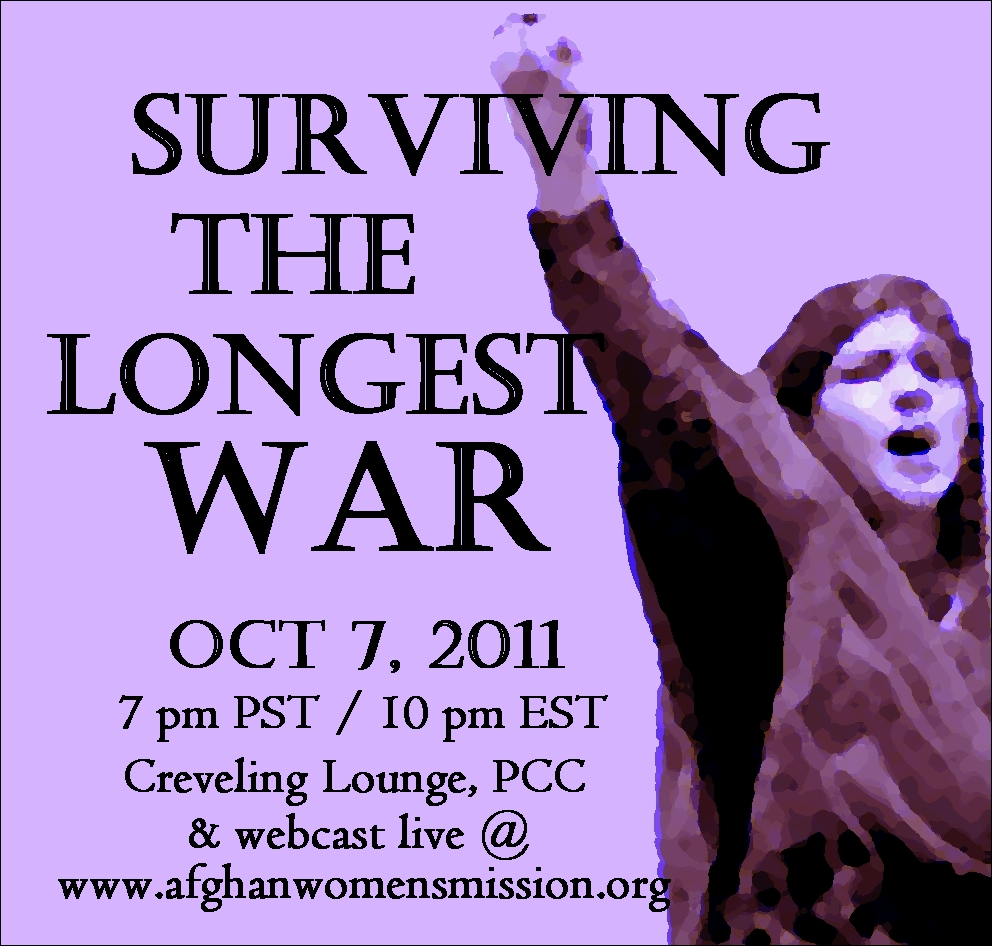
On the 10th Anniversary of the U.S. war, an underground activist tells the real story of the Occupation & Afghan Resistance

Reena, a member of the Revolutionary Association of the women of Afghanistan (RAWA), will address American audiences via live video stream.

RSVP for the event on Facebook.

Download the flyer here.

AWM Co-Director and KPFK’s Uprising host Sonali Kolhatkar will lead the conversation with Reena via video streaming in front of a live audience. The event will be webcast live on AWM’s website. Questions will be drawn from the in-person audience, and the online audience via Facebook.

WHEN: Friday Oct 7 2011 7pm PST / 10 PM EST
WHERE: Creveling Lounge (CC bld, 2nd floor) PCC campus, Pasadena California or @afghanwomensmission.org.

Open to the public. Entrance is free. There will be books and crafts available for sale.

If you are unable to attend this event, you can watch a live webcast of the entire event on this website! Click here to find out the time of the webcast in your city.

Organized in collaboration with PCC’s Students for Social Justice. KPFK is a media sponsor.

Posted in AWM News, Featured, SoCal Events | Comments Off on AWM Marks Tenth Anniversary of the Afghanistan War

Video Message from Malalai Joya on 10th Anniversary of US War

Former Afghan MP, Human Rights Activist and Author of “A Woman Among Warlords,” Malalai Joya, recorded this message on the Tenth Anniversary of the War and Occupation of Afghanistan:

Transcript of Joya’s message:

Hi everyone, I would like to thank all supporters and anti-war movements around the world who are marking the dark day of occupation of U.S. and NATO in Afghanistan.

Respected friends – 10 years ago the U.S. and NATO invaded my country under the fake banners of women’s rights, human rights, and democracy. But after a decade, Afghanistan still remains the most uncivil, most corrupt, and most war torn country in the world. The consequences of the so-called war on terror has only been more bloodshed, crimes, barbarism, human rights, and women’s rights violations, which has doubled the miseries and sorrows of our people.

During these bloody years, tens of thousands of innocent civilians have been killed by occupation forces and terrorist groups. When Barack Obama took office in 2008, unfortunately his first news for my people was more conflict and more war. It was during Obama’s administration that civilian death tolls increased by 24%. And the result of the surge of troops of Obama’s administration is more massacres, more crimes, violence, destruction, pain, and tragedy. That’s why he has proved himself as a warmonger — as second even more dangerous Bush.

According to the Afghanistan Right Monitor in 2010, 7 civilians were killed everyday. U.S. and NATO tell us they will leave Afghanistan by the middle of 2014, but on another hand they’re talking about U.S. permanent military bases in Afghanistan. They will not leave our country soon. They are there for their own strategic regional and economic interests. That is why they want to change Afghanistan into a military and intelligence base in Asia.

The western governments not only betray Afghan people, they betray their own people too. They are wasting their taxpayer money in the blood of their soldiers by supporting a war, which only safeguard the interests of the big corporations and the Afghan criminal warlord rulers.

I think democracy never comes by military invasion. Democracy without independence and justice is meaningless. It is only the nation who can liberate themselves.

I believe that the only solution for the catastrophic situation of Afghanistan is withdrawal of ALL of the troops of our country because their presence is making much harder our struggle for justice and peace. By empowering the reactionary dark minded terrorist groups who are great obstacles for true democratic minded elements. If honestly they leave Afghanistan , the backbone of fundamentalist warlords in Taliban will break.

I hope one-day Afghanistan also will see the glorious uprising like in Middle East countries. As right now we are witnessing the small uprising in some provinces in Afghanistan like Herat, Kunar, Nangarhar, Mazar-e-Sharif, Farah, Kabul, and many other provinces which is a big source of hope for the bright future of Afghanistan.

So now I would like to ask all peace-loving, justice-seekers, anti-war movements and democratic-minded intellectuals, individuals around the world to join their hands with democratic-minded people of our country who are able to fight against fundamentalism and occupation. Therefore, my message to you is please empower my people educationally, as I believe education is a key against ignorance and toward emancipation.

Thank you very much.

Long live freedom. Down with Occupation.

Find out more about Joya at www.malalaijoya.com.

Posted in AWM News, Featured | Comments Off on Video Message from Malalai Joya on 10th Anniversary of US War

Tenth Anniversary of Afghanistan War: RAWA Member Available for Interviews

For Immediate Release

E-mail: press[at]afghanwomensmission[dot]org

Surviving the Longest War: An International Video Webcast
On the Tenth Anniversary of the US war, an underground activist
tells the real story of the Occupation and Afghan Resistance

October 7th 2011, marks the ten year anniversary of the United States’ invasion of Afghanistan. To mark this event, Afghan Women’s Mission (AWM), a U.S.-based non-profit that works in solidarity with the Revolutionary Association of the Women of Afghanistan (RAWA) will hold a special international online talk-back with Reena, a member of RAWA.

“Ten years of war has not made Afghanistan safer for anybody except the fundamentalist warlords in the Afghan government, and the Taliban,” said Reena. This anniversary event, in collaboration with PCC’s Students for Social Justice, will raise serious questions about the official story of the longest war the U.S. has ever officially waged, and will offer the unique perspective of an underground Afghan activist who has witnessed first-hand the impact of the war.

AWM Co-Director and KPFK’s Uprising host Sonali Kolhatkar will lead the conversation with Reena via live video streaming from the Pakistan/Afghanistan region, in front of a live audience. The event will be webcast live on AWM’s website at www.afghanwomensmission.org .

“Using the latest technology available, we are thrilled to be able to broadcast the voice of this young RAWA member – an Afghan speaking for her generation – well beyond the confines of our physical event,” said Kolhatkar. “We invite people from all over the world to mark the tenth anniversary of this war by tuning into our live web video stream of our conversation with Reena.”

Questions for RAWA member Reena will be drawn from the live in-person audience and the online audience via Facebook. The event will take place on Friday October 7th at 7pm PST (10 pm EST) at Creveling Lounge (CC Building, 2nd floor) on the campus of Pasadena City College (PCC).

Nineteen year old Reena was born an Afghan refugee in Pakistan around the time when US-backed fundamentalist fighters started a brutal civil war in Afghanistan. She lived with her family in the border town of Peshawar in severe and impoverished conditions. After moving to a refugee camp run by RAWA, Reena attended one of their literacy courses. She eventually joined the organization, working in various RAWA-run schools and orphanages and is currently a first-year University student. Since Reena was born, she has known only war in her country.

Read Sonali Kolhatkar’s September 11th, 2011 interview with Reena here.

RAWA is on the forefront of the movement for peace in Afghanistan. Their activities focus on women’s rights, human rights, and exposing the fundamentalist crimes of warlords in power, as well as the Taliban. They have criticized all foreign intervention since the time of the Soviet invasion and occupation through to today’s US/NATO war. As the oldest women’s political organization in Afghanistan, RAWA has been promoting human rights and democracy for more than 30 years. Their work is extremely dangerous – all RAWA members, including Reena, use pseudonyms, do not reveal their faces, and live and work underground.

RAWA Predicted the Failure of the War Ten Years Ago

On September 14th 2001 RAWA issued a statement warning the US against waging war on Afghanistan, saying “vast and indiscriminate military attacks on a country that has been facing …disasters for more than two decades will not be a matter of pride.”

On October 11th 2001, four days after the bombs began dropping on Afghanistan, RAWA once more urged the US to do the right thing, predicting accurately the outcome of the war in a statement: “[t]he continuation of US attacks and the increase in the number of innocent civilian victims not only gives an excuse to the Taliban, but also will cause the empowering of the fundamentalist forces in the region and even in the world.”

A month after the war began, when the Taliban were rapidly pushed out of Kabul, RAWA realized that the US was ready to replace the Taliban with their ideological brethren, the Northern Alliance (NA) warlords. They issued yet another international appeal, warning: “[t]he NA will horribly intensify the ethnic and religious conflicts and will never refrain to fan the fire of another brutal and endless civil war in order to retain in power.”

Sadly RAWA’s warnings were ignored and the last ten years have borne out their predictions.

The Human Impact of a Decade of War

Civilian casualties as a result of the ten year long Afghanistan war have been estimated at 17, 611 – 37, 208, with more than half killed directly as a result of U.S.-led military actions (Sources: UN Assistance Mission Afghanistan, Afghan Independent Human Rights Commission, Human Rights Watch, and Associated Press). A recent report by Open Society Foundation found that night raids conducted regularly by US and NATO forces in Afghan villages result in indiscriminate detentions and widespread abuse.

Politically things aren’t much better. Afghanistan’s government, dominated by the US-backed NA warlords whom RAWA warned against, is ranked the second most corrupt in the world after Somalia (Transparency International). Through the Afghan parliament, warlords have passed laws exempting themselves from prosecution for war crimes, curtailing press freedoms, and promoting women’s abuse.

Women in particular continue to suffer. A survey by UNIFEM in January 2011 revealed that a shocking 87% of Afghan women are victims of domestic violence. A UK based charity, Womankind, found that “between 60 and 80 percent of Afghan marriages are forced, with more than half of all girls married before age 16.” While women can run for office in the Afghan parliament, they are only allowed to serve if they accept the status quo. The well-known and popular activist, Malalai Joya, a representative of Farah province, was kicked out of Parliament for criticizing the US-backed warlords and has survived numerous assassination attempts.

According to RAWA member Reena, the first thing that needs to happen is for Americans to “call for the withdrawal of the troops, as the military presence has not helped Afghan people in any way.” Her opinion is supported by a majority of Americans: a Washington Post-ABC News poll in March showed that 64% of poll participants somewhat or strongly felt that the war has not been worth fighting.

RAWA member Reena is available for a limited number of interviews.

Posted in Press Releases | Comments Off on Tenth Anniversary of Afghanistan War: RAWA Member Available for Interviews

Gareth Porter: Taliban Hijack the US’s Narrative

By GARETH PORTER
Inter Press Service

WASHINGTON – General David Petraeus wrote in his 2006 counter-insurgency manual that the United States command headquarters should establish a “narrative” for the counter-insurgency war – a simple storyline that provides a framework for understanding events, both for the population of the country in question and for international audiences.

But this week’s Taliban attacks on multiple targets in Kabul, including the US Embassy and US-North Atlantic Treaty Organization headquarters, are the latest and most spectacular of a long series of operations that have given the insurgents the upper hand in establishing the narrative of the war as perceived by the Afghan population.

Those attacks and other operations that generated headlines in 2010 have been aimed at convincing Afghans that the Taliban can strike any target in the country, because they have their own agents within the Afghan government’s military, police and administrative organs.

In the wake of the latest attacks, the Taliban war narrative achieved a new level of influence when a political opponent of President Hamid Karzai associated with a prominent Pashtun warlord charged that the Taliban could not have pulled off such a sophisticated set of coordinated attacks in the center of the capital without help from within the Afghan security apparatus.

The Taliban have mounted three high-profile attacks in Kabul over the past three months involving suicide bombers and commandos with rocket-propelled grenades.

In late June, six suicide bombers attacked the Intercontinental Hotel, the favorite spot in the capital for Westerners to hold conferences, which left the hotel in darkness for many hours.

And in August, the insurgents carried out a much more complex attack on the British Council, a semi-governmental agency involved in organizing cultural events. The attack involving a suicide bombing at a key intersection in western Kabul followed an attack on the police checkpoint guarding the British Council, and a suicide car bomb that destroyed the wall around the council and allowed the team of suicide attackers to enter the compound.
Attacks on the capital were supposed to have been made impossible by a “ring of steel” around the city. After the Taliban had carried out an attack in downtown Kabul in January 2010, the Afghan police, with funding and advice from the US military, set up a system of 25 security checkpoints around the capital that is guarded by 800 officers of the Kabul City Police Command battalion.

Nevertheless, the insurgents were able to smuggle weapons, including rocket-propelled grenade launchers, through the cordon and sustained an all-day attack on the International Security Assistance Force (ISAF) headquarters.

For the first time, a prominent political figure in Kabul has charged that the attackers must indeed have had help from people within the Afghan government’s security apparatus.

Mohammed Naim Hamidzai Lalai, chairman of the parliament’s Internal Security Committee and a political ally of powerful Pashtun warlord Gul Agha Sherzai, charged that the “nature and scale of today’s attack” showed that the Taliban had gotten “assistance and guidance from some security officials within the government who are their sympathizers”, according to the New York Times.

“Otherwise it would be impossible for the planners and masterminds of the attack to stage such a sophisticated and complex attack, in this extremely well-guarded location without the complicity from insiders,” he said.

Central to the Taliban strategy has been a series of assassinations of top Afghan government figures that has demonstrated their ability to place their own agents within the most secure spots in the country.

In mid-April, a Taliban suicide bomber wearing a policeman’s uniform was able to penetrate security outside the Kandahar police headquarters and kill the provincial police chief.

On May 28, a Taliban suicide bomber who had been able to gain access to the governor’s compound in Takhar province detonated his suicide vest in the hallway outside a meeting room and killed the police chief for northern Afghanistan, General Mohammad Daud Daud.

In July, Ahmed Wali Karzai, the half-brother of President Karzai and the Mafia-style political boss of Kandahar province, was killed by the long-time head of his security detail, Sardar Mohammad. Mohammad had been trusted by US Special Forces and the Central Intelligence Agency, who had very close ties with Wali Karzai.

But Mahmoud Karzai, another brother of the president, told Julius Cavendish of The Independent of London a few days after the assassination that Mohammad had made a trip to Quetta in Pakistan and had met with the Taliban, and that he had been getting phone calls in the middle of the night. The Karzai family had concluded that Mohammad had been recruited by the Taliban to kill Wali Karzai, according to the brother.

Perhaps the most important element in building the Taliban narrative has been the constant drumbeat of attacks by Afghan soldiers and policemen on US and NATO troops. According to official NATO figures, between March 2009 and June 2011, at least 57 foreign troops, including 32 Americans, were killed in at least 19 such attacks.

United States military and intelligence officials reluctantly concluded that that most, if not all, of the attacks had been the result of recruitment by the Taliban intelligence service of Afghan security personnel to kill US and NATO troops, at obvious risk to themselves.

In June, the US decided to send an unknown number of counter-intelligence agents to tighten procedures for identifying troops who might be more likely to be recruited by the Taliban.

Adding to the Taliban war narrative was the carefully-planned breakout of nearly 500 prisoners from the security wing of Sarposa prison in Kandahar city after a few prisoners spent months digging a 300-meter tunnel. The breakout was possible only with the help of a Taliban underground agent or sympathizer who provided copies of keys to the cells, with which Taliban prisoners involved in the plan could unlock the cells of their fellow prisoners and so they could escape through the tunnel.

Two weeks later, the Taliban carried out a complex attack on key government targets in Kandahar city, including the governor’s office, the Afghan intelligence agency and the police station. The offensive in Kandahar involved seven explosions across the city, six of which were the result of suicide bombers.

The Taliban were able to strike freely in Kandahar despite what Canadian Brigadier-General Daniel Menard had called a “ring of stability” – a security cordon that supposed to keep Taliban fighters from getting into the city.

In February 2010, Menard, who was commander of Task Force Kandahar for the ISAF, had boasted that, with a total of nearly 6,000 US and Canadian troops deployed against Taliban forces in Kandahar province, “I can literally break their back.”

But the Taliban continued to operate freely in the city. As Peter Dmitrov, a former Canadian military officer who was working as a security consultant to non-governmental organizations in Afghanistan, observed last November to The Canadian Press, “The ring hasn’t really shut closed in any way, shape or form.”

The US war strategy has been based at least in part on convincing Afghans that the United States would remain in Afghanistan indefinitely, and that the Taliban would weaken. But the Taliban war narrative that it is able to penetrate the even the tightest security and cannot be defeated appears to have far more credibility with Afghans of all political stripes than the narrative put forward by US strategists.

Gareth Porter is an investigative historian and journalist specializing in US national security policy. The paperback edition of his latest book, Perils of Dominance: Imbalance of Power and the Road to War in Vietnam, was published in 2006.

(Inter Press Service)

Posted in Afghanistan News Wire, Featured | Comments Off on Gareth Porter: Taliban Hijack the US’s Narrative

US-Backed Fundamentalists in Afghan War No Different From 9/11 Perpetrators

AWM’s Sonali Kolhatkar Interviews a Member of RAWA

Ten years ago, when the terrorist attacks took place on September 11th, 2001, my colleagues and I in the Afghan Women’s Mission watched in shock and horror as thousands of innocent people lost their lives. We knew right away however, that retaliation would be aimed at Afghanistan and that all Afghans, including the women of the underground organization RAWA who we worked in solidarity with, would become targets of American bombs.

On September 14th, 2001, RAWA issued a statement entitled “The people of Afghanistan have nothing to do with Osama and his accomplices.” In it, they expressed their condolences, and warned that past U.S. policy had led to this day:

RAWA stands with the rest of the world in expressing our sorrow and condemnation for this barbaric act of violence and terror. RAWA had already warned that the United States should not support the most treacherous, most criminal, most anti-democracy and anti-women Islamic fundamentalist parties because after both the Jehadis and the Taliban have committed every possible type of heinous crimes against our people, they would feel no shame in committing such crimes against the American people whom they consider “infidel”. In order to gain and maintain their power, these barbaric criminals are ready to turn easily to any criminal force.

RAWA went on to urge the US against launching a war: “vast and indiscriminate military attacks on a country that has been facing …disasters for more than two decades will not be a matter of pride.”

On October 11th, four days after the bombs began dropping on Afghanistan, RAWA once more urged the US to do the right thing, predicting accurately the outcome of the war: “[t]he continuation of US attacks and the increase in the number of innocent civilian victims not only gives an excuse to the Taliban, but also will cause the empowering of the fundamentalist forces in the region and even in the world.”

A month later, when the Taliban were rapidly pushed out of Kabul, RAWA realized that the US was ready to replace the Taliban with their ideological brethren, the Northern Alliance (NA) warlords. They issued yet another international appeal, warning: “[t]he NA will horribly intensify the ethnic and religious conflicts and will never refrain to fan the fire of another brutal and endless civil war in order to retain in power.”

Sadly RAWA’s warnings were ignored and the last ten years have borne out their predictions. The Afghan war continues with no end in sight, and with an increasing empowered Taliban, corrupt central government dominated by members of the Northern Alliance, and ordinary people caught in the crossfire.

On this tenth anniversary of the September 11th attacks, I interviewed a member of RAWA who goes by the name, Reena.

Sonali Kolhatkar: What was your reaction when you first heard about the terrorist attacks in New York and Washington ten years ago? Did you have any idea that within a month, the U.S. would begin attacking Afghanistan?

Reena: Well, the first reaction of course, was the whole world was shocked. We were also shocked and of course sad for the innocent people who were killed in the World Trade Center. But what the U.S. then did was a pretty natural reaction for us, as you know with the history of the U.S. we know that invading in other countries is their policy. But, what we were most scared of and what we braced ourselves for was that they would install the old criminals and enemies of the Afghan people, that is the Northern Alliance under a nice cover as a democratic government. This was something we predicted, and we also predicted much worse conditions as compared to those under the Taliban.

Sonali Kolhatkar: Would you say that the same forces, the same ideology that manifested itself in the U.S. on September 11, 2001, is affecting and oppressing women inside Afghanistan?

Reena: Well, yes, in a different way. You see, fundamentalism is global, and it is just under different brands in every place. But, what it does to women, what it does to people, what it does if it comes to power, is the same everywhere. So, fundamentalism under the name of Taliban, fundamentalism under the name of jihadis, or Northern Alliance, or let’s just say under the name of the Iranian government, or some other terrorist group in some other part of the world, does the same thing, if they come to power, if they are empowered the way the U.S. has empowered the warlords.

Sonali Kolhatkar: Many Americans didn’t know the history of U.S. support for fundamentalist forces in Afghanistan as well as for the many Arab fighters that came to Afghanistan to fight the Soviet Union. Here in the United States, Americans were surprised about the consequences on 9/11, but in Afghanistan, it seemed as though most people weren’t surprised.

Reena: Yes, absolutely. You just need to look at the history, and unfortunately, these very important things don’t get mainstream media attention in the U.S. But if you just look at the recent history, you can very clearly see that America’s policy has always been to use the fundamentalists for its own interest, as it did thirty years ago with the Mujahideen, as it presently does with some terrorist groups, as it has always been doing. If you just read a good history book, it’s just plain. They’ve always helped the Mujahideen and the warlords, as long as it was for a bit of trust in overthrowing the Soviets, and then coming to power, and today allowing U.S. to have its bases, and military presence in everything, so it’s good as long as it’s in its interest. They will support anything, including such brutal fundamentalists.

Sonali Kolhatkar: Now, RAWA was for years speaking out through your website internationally and via other means, about the oppression of women by the Taliban. How did you respond when President Bush began, and his wife Laura Bush began using women’s rights as one of the reasons to launch the war in Afghanistan?

Reena: Well, using women’s rights seemed very ridiculous from the very start. We have always said that Bush, that America itself brought back to power, the Northern Alliance warlords. They are never going to be doing something beneficial for women. The conditions of women are worse, as we have seen now. But, it wasn’t ever going to help them. So, you know, it was very ridiculous that Mr. Bush and Laura Bush wanted to help the Afghan women and people. If they did, they wouldn’t have installed these criminals. They wouldn’t have given them so much power. There are many democratic groups in Afghanistan; maybe they could have, you know, negotiated with them, talked to them. From the very start, it seemed like the most ridiculous thing to do to bring such fundamentalists back to power and using women as an excuse to invade a country. But, they were not really helping them with such fundamentalists in power, as proven after ten years of the occupation, and of the rule of these warlords.

Sonali Kolhatkar: So, in the past nearly ten years now under the U.S. and NATO occupation – I know it’s a very big question to ask – how have women’s rights been set back over ten years, specifically regarding the laws that the Afghan Parliament has passed that have been very misogynist, and the way in which the U.S.-backed government’s judicial system has attacked women? Are things today, legally and politically speaking, worse for women than under the Taliban, or are they about just as bad?

Reena: Well, the laws that you just mentioned are not getting enough attention – that is one of the things that affects women badly. But basically in Afghanistan there is no legal system, there is no judiciary. There is nothing to protect women if they’re being abused, or they’re being hurt, or need help. So there is no proper legal system to prosecute people and bring them to justice. If there is a legal system, it is used in the interest of the warlords who are in power. For example, the Parliament is using their power to pass such laws. The judiciary will pass very controversial sentences which according to them are in accordance with Sha’aria law. There is no law, and if there is, it’s in the hands of these warlords who twist and turn them for their own benefit, according to their own misogynist mentality, and use it against women. So there is no protection or justice whatsoever for the bereaved women of Afghanistan.

Sonali Kolhatkar: Ten years after the September 11th attacks happened, there’s still a lot of ignorance about Afghanistan. Even though we have been fighting a war there longer than any other war in U.S. history, there’s still so much ignorance. What do you recommend for Americans to do about the war, and to better educate themselves?

Reena: People should consult RAWA’s website, www.rawa.org, well as our news section on that site, for daily updates on Afghanistan and the horrible things that happen to women over there. As for what American people can do, as we’ve always said, I think they should first of all call for the withdrawal of the troops, as the military presence has not helped Afghan people in any way. That has been proven in the past ten years. And, as I said before, there are truly democratic groups in Afghanistan that can actually help the Afghan people. But the U.S. military bases and troops are not required for this. These warlords have to be disarmed, have to be removed from power, and then maybe we can talk about a better Afghanistan and women’s rights.

Reena is a member of RAWA, the Revolutionary Association of the Women of Afghanistan. Sonali Kolhatkar is the Co-Director of the Afghan Women’s Mission, and host of Uprising on KPFK Pacifica Radio.

This interview has been edited for clarity. The audio portion will be broadcast nationally on Sunday September 11th 2011 as part of Pacifica Radio’s 9/11 Anniversary Special. Special thanks to Sana Shuja for transcribing.

Posted in AWM News, Featured | Comments Off on US-Backed Fundamentalists in Afghan War No Different From 9/11 Perpetrators

Joya Successfully Wraps Up 2011 US Tour – A Reportback

Although initially denied a travel visa from the US government, Malalai Joya, with the help of her supporters, successfully petitioned the United States for a visa and wrapped up a successful book tour in the US in early 2011.

Citing she was “unemployed” and “lives underground,” the US embassy refused to allow Joya into the country. Joya’s supporters responded in full force. On March 23, they staged a national call-in day to Secretary of State Hillary Clinton, organized a petition garnering over 3,000 signatures, and executed a nationwide campaign involving Senators and Congressmen. On March 24, the US granted Joya a visa.

Although Joya was forced to miss her events in New York and Washington DC, they were rescheduled to the end of her tour where the public had the opportunity to hear her speak.

On March 25, Joya began her tour at Harvard University’s Memorial Church in Cambridge, MA, speaking alongside world renowned Professor Noam Chomsky.

Due to last minute schedule changes caused by her visa denial, Joya arrived only three hours before the event. Nevertheless, she was able to speak at the event and draw a crowd of over 1,200 people. Watch a video recording of the entire event on YouTube here. Click here here to read a report of the event.

Joya continued her tour at the First Church in Jamaica Plain, MA on March 26. More than 250 people attended, and Joya received a standing ovation at the end of her speech. Read a Boston Globe report about her Massachusetts events here.

The next day, Joya spoke at the University of Vermont in Burlington on March 27 to over 200 people, many of them students. She went on to attend a women’s legislative breakfast, meeting with several state lawmakers from Vermont.

On March 28, Joya spoke at the University of Massachusetts and Smith College in Massachusetts. Crowds for both events totaled over 400 including hundreds of students, and they expressed a very favorable response to Joya’s message.

Joya spoke at the University of New Hampshire on March 29 to a crowd of 250. Her books sold out at the event, and many people signed the Peace Action petitions circulated there.

On March 30, Joya continued her tour at Villanova University and Arch Street Meeting House in Philadelphia, PA. Over 100 people attended her event at Arch Street to hear her speak and participate in a question and answer session.

Joya traveled to Chopin Theater in Chicago, Illinois on March 31 and was met with a packed theater. After the event, she was interviewed by the National Public Radio (NPR).

On April 1, Joya visited Minneapolis, Minnesota to speak at St. Joan of Arc Church. Click here here for additional coverage.

On April 3, Joya continued her book tour at Willamette University in Salem, Oregon where she was well-received. At the end of her speech, the audience gave her a minutes-long standing ovation. Click here here for a report on the event.

On April 4, Joya visited Washington State to speak at Western Washington University in Bellingham, Edmonds Community College in Lynnwood, and Seattle First Baptist Church. The event at Seattle First Baptist Church drew a crowd of 600. Approximately 50 new potential donors and members were identified at the Washington State events. Local Afghans attended the events as well.

Joya spoke at the University of Washington-Tacoma on April 5. She addressed the Afghan people’s struggles amidst the occupation and an increase of civilian casualties under President Obama. Click here here for more details.

On April 6, Joya lectured at the Central Washington University in Ellensburg. Over 400 people attended the event, filling the capacity of the theater it was held in.

Joya continued her book tour in Southern California where Afghan Women’s Mission is based. She began at California State University, Los Angeles at an event attracting more than 400 students, faculty, and members of the public. Afterwards, she spoke at the University of Southern California with more than 300 people in attendance.

The next day on April 8, Joya spoke at UC Santa Barbara and Golden West College. The UC Santa Barbara event was packed with more than 200 people in attendance and some even sitting in the aisles. Joya received a standing ovation at the end of that event followed by a crowded booksigning. At Golden West College, more than 350 people attended, including the President of the college, and she received another standing ovation.

Click here to view AWM’s photo report of all Southern California event.

Joya then took her tour up north to San Francisco, CA from April 9-11. She spoke at the Episcopal Church of St. John the Evangelist on April 9 and was accompanied by the music of singer and songwriter Kaylah Marin. On April 10, Joya attended and spoke at an antiwar rally held at Dolores Park. Click here here for video footage. On April 11, Joya spoke at the University of San Francisco.

Another speaking event was held at the St. Mary’s College of Maryland on April 13. Despite rescheduling and short notice, more than 100 people attended the event including many students.

For her last stop, Joya joined playwright and activist Eve Ensler at the CUNY Graduate Center in New York for a dialogue on the experience of Afghan civilians, particularly women, in face of the war and how the US can support their struggles. The audience was very supportive of Joya and gave her several standing ovations throughout the night. While in New York, she also met with members of Iraq Veterans Against the War, participated in a community gathering of various organizations, and had press interviews.

This report was authored by Chan Peter Kim, USC intern for AWM.

Posted in Featured, Reports | Comments Off on Joya Successfully Wraps Up 2011 US Tour – A Reportback

Joya’s Southern California Tour – A Photo Report

On April 7-8, 2011, Malalai Joya, renowned Afghan activist, returned to Southern California on the occasion of the release of her book, A Woman Among Warlords, in paperback. Part of her national tour (read report here), Joya’s time in Southern California, where Afghan Women’s Mission is based, was packed with 4 geographically diverse events attended by hundreds of people.

California State University of Los Angeles – April 7, 2011


Joya addresses a crowd of more than 400.


Mostly students and faculty attended the event.


A slide show accompanied Joya’s presentation.


A view of the audience at CSULA in the University Student Union LA Room.


A book and poster signing followed the event.


A supporter hugs Joya.

Special thanks to Students for Social Justice at CSULA and Earth LA for organizing the event.

University of Southern California – April 7, 2011


A large audience gathered at Taper Hall of Humanities, Room 201.


Joya addresses the crowd.


Joya shares an image of one-time Taliban member turned Yale University student, Sayed Rahmatullah Hashemi.


USC student and AWM intern Chan Peter Kim thanks Joya for attending and offers a token of appreciation from his fellow student organizers and himself.


A book and poster signing follows the event.


Joya signs a copy of her book, A Woman Among Warlords.


Joya interacting with audience members after her presentation.


Joya with USC student and AWM intern Chan Peter Kim.


USC student and AWM intern Alia Delpassand helps Joya with translating questions during the event.


AWM volunteer and photographer Alice Chiu looks on as Joya signs books.

Special thanks to the USC Political Student Assembly for organizing the event.

University of California at Santa Barbara – April 8, 2011


People gather outside the Multicultural Center on the UC Santa Barbara campus where Joya spoke.


Copies of Joya’s book, A Woman Among Warlords, were available for sale.


Janet Afary of UCSB’s Department of Feminist Studies introduced Joya, with Nancy Gallagher of the UCSB History Department in the background. Both co-organized the event.


Joya addresses a packed audience hall.


Hundreds of Santa Barbarans attended the event including many high school students.


Uprising interns Natalie Reyes and Chan Peter Kim staffed the book and poster sales table.


Many audience members stayed for a vigorous question-and-answer session.


Joya shares her accompanying slide show.


Dozens of people wait in line to get their books and posters signed.


Joya chats with members of the audience.

Special thanks to the UCSB Multicultural Center and Mellichamp Fund – Department of Religious Studies for organizing the event.

Golden West College, Huntington Beach – April 8, 2011


Joya addresses hundreds of Orange County residents at Golden West College.


The event was attended by Golden West’s President, Wes Bryan.


Members of the media record the event.


Joya answers questions from the audience.


Audience members gather for a book and poster signing.


Joya signs a copy of her book A Woman Among Warlords.


Joya shakes hands with a supporter.


The team at Afghan Women’s Mission that organized all four events in Southern California, posing with Joya. From left to right: Natalie Reyes, Sonali Kolhatkar (AWM Director), Malalai Joya, Chan Peter Kim, Alia Delpassand, Alice Chiu.

All photographs taken by AWM volunteer, Alice Chiu.

Posted in Featured, Reports | Comments Off on Joya’s Southern California Tour – A Photo Report

Vote for Malalai Joya – 9th Annual Human Rights Award

Vote for JoyaMalalai Joya, former Afghan MP and author of A Woman Among Warlords, has been nominated for the 9th Annual Global Exchange Human Rights Award, as part of the People’s Choice Contest.

Posted in AWM News, Campaigns | Comments Off on Vote for Malalai Joya – 9th Annual Human Rights Award