By ROD NORDLAND
The New York Times
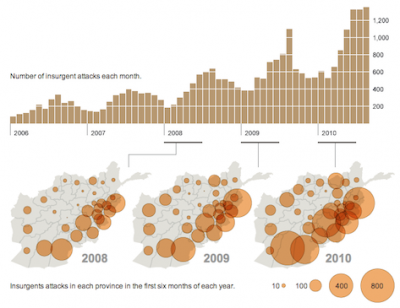
KABUL, Afghanistan — Even as more American troops flow into the country, Afghanistan is more dangerous than it has ever been during this war, with security deteriorating in recent months, according to international organizations and humanitarian groups.
Large parts of the country that were once completely safe, like most of the northern provinces, now have a substantial Taliban presence — even in areas where there are few Pashtuns, who previously were the Taliban’s only supporters. As NATO forces poured in and shifted to the south to battle the Taliban in their stronghold, the Taliban responded with a surge of their own, greatly increasing their activities in the north and parts of the east.
The worsening security comes as the Obama administration is under increasing pressure to show results to maintain public support for the war, and raises serious concerns about whether the country can hold legitimate nationwide elections for Parliament next Saturday.
Unarmed government employees can no longer travel safely in 30 percent of the country’s 368 districts, according to published United Nations estimates, and there are districts deemed too dangerous to visit in all but one of the country’s 34 provinces.
The number of insurgent attacks has increased significantly; in August 2009, insurgents carried out 630 attacks. This August, they initiated at least 1,353, according to the Afghan N.G.O. Safety Office, an independent organization financed by Western governments and agencies to monitor safety for aid workers.
An attack on a Western medical team in northern Afghanistan in early August, which killed 10 people, was the largest massacre in years of aid workers in Afghanistan.
“The humanitarian space is shrinking day by day,” said a CARE Afghanistan official, Abdul Kebar.
The International Security Assistance Force, or ISAF, does not routinely release detailed data on attacks around the country, and the Afghan government stopped doing so in mid-2009. United Nations officials have also stopped releasing details of attacks, though they monitor them closely. Requests for access to that information were denied.
ISAF officials dispute the notion that security is slipping from them, pointing to their successes with targeted killings and captures of Taliban field commanders and members of the Taliban shadow government.
American military officials say the increased level of violence is related to the rise in the number of its forces here. The last 2,000 of 30,000 new American troops are expected to arrive in the next week or two, military officials say. The result is more military operations, they say, and more opportunities for the insurgents to attack coalition forces.
That does not entirely explain the increased activity of the Taliban in areas where they were seldom seen before, and where the coalition presence is light, however.
Last year, American military leaders adopted a strategy of concentrating operations in what they identified as 80 “key terrain districts,” mostly in the south and east of the country, less than a fourth of Afghanistan’s districts.
The idea was to attack the Taliban where they were strongest, and concentrate forces where populations were largest.
While how many fighters the insurgents have is a matter of estimate and conjecture, the impact they have had is easy enough to judge.
Last month, ISAF recorded 4,919 “kinetic events,” including small-arms fire, bombs and shelling, a 7 percent increase over the previous month, and a 49 percent increase over August 2009, according to Maj. Sunset R. Belinsky, an ISAF spokeswoman. August 2009 was itself an unusually active month for the insurgency as it sought to disrupt the presidential elections then.
With one attack after another, the Taliban and their insurgent allies have degraded security in almost every part of the country (the one exception is Panjshir Province in the north, which has never succumbed to Taliban control).
The Afghan N.G.O. Safety Office says that by almost every metric it has, Afghanistan is more dangerous now than at any time since 2001.
The most recent troop buildup comes in response to steady advances by the Taliban. Four years ago, the insurgents were active in only four provinces. Now they are active in 33 of 34, the organizations say.
“We do not support the perspective that this constitutes ‘things getting worse before they get better,’ ” said Nic Lee, director of the Afghan N.G.O. Safety Office, “but rather see it as being consistent with the five-year trend of things just getting worse.”
Despite the spread of the conflict, humanitarian organizations say they are still able to serve Afghans in much of the country. They have to be much more careful, restricting their movements and pulling back from some areas altogether.
They use Afghan workers rather than international staff members. They avoid travel by road and take greater security precautions. They have also taken to operating incognito as a matter of routine. As a result, while insurgent attacks have more than doubled since last year, attacks on N.G.O.’s have actually declined by 35 percent, Mr. Lee said.
Because of the lack of security, CARE, like many humanitarian groups, no longer uses the country’s principal highway, the Grand Trunk Road connecting Kabul, the capital, to Peshawar in Pakistan. CARE has 10 offices around the country to manage its 1,000 employees, but its own international staff members can safely visit only four or five of them, according to a spokeswoman, Jennifer Rowell.
Likewise, there is no longer an Oxfam sign on display in the entire country, although the British-based aid group finances projects in scores of villages, mostly staffed by Afghans.
“Most N.G.O.’s don’t send foreigners to most places any longer,” said Ashley Jackson, head of policy and advocacy for Oxfam in Kabul, referring to nongovernmental organizations. Like many major aid groups, Oxfam now subcontracts much of its work in the provinces to partners, usually Afghan aid groups.
The threat to government workers is just as severe. Last month, Afghan police and army officials asked the Independent Election Commission to cancel 938 of its proposed 6,835 polling centers, almost 14 percent, because it could not guarantee security for those areas. Polling places in 25 provinces were affected.
On Tuesday the election commission said it would cancel 81 other polling sites, nearly a fifth of the polling places in eastern Nangarhar Province, which was relatively safe during last year’s presidential election. The commission has warned that it may have to close still more polling centers in other provinces if the authorities cannot provide adequate security for voters.
Only 500 international observers are coming to monitor these elections, compared with more than a thousand last year, according to Jindad Spinghar of the Free and Fair Election Foundation. International observers will be able to go only to provincial capitals, not rural areas, where most of the population lives, he said. The election foundation, the leading Afghan monitoring group, has had to cut back its own observers, who will be watching only 60 percent of polling places.
“Because the control of the central government is decreasing,” Mr. Spinghar said, “power brokers and warlords will be able to use their influence at the local level, where there are no observers.” It was in just such areas in 2009 that widespread voting fraud took place, resulting in a disputed and internationally discredited presidential election.
Military officials counter that they are making headway against the Taliban. Gen. David H. Petraeus, the ISAF commander, said recently that NATO forces had killed or captured 2,974 insurgents this summer, 235 of them commanders. Last December, the military assessed Taliban strength at 25,000.
“While we do not routinely release data on total attacks around the country, we did expect the number of attacks to go up as the number of ISAF troops increased,” said Major Belinsky, the ISAF spokeswoman.
“We are pushing into areas where the Taliban have enjoyed safe haven in the past, and we are taking that away from them,” Major Belinsky said. “They are putting up a tough fight, with more tough fighting to come, but we are making progress.”
A top coalition general bristled recently when asked about views among some critics that NATO was losing the fight. “How do they know we’re losing? I can lay out rhyme and reason about where we’re making progress. We’re building, they’re destroying. I say to them, prove it.”
Multimedia presentation on insecurity.



 Among the various healthcare projects run by
  The clinic is equipped with a medical laboratory including equipment to treat eye health, and an ambulance to transport patients to Peshawar in case of emergency. Due to the lack of other medical facilities, Malalai Clinic provides healthcare to women, children, and men.
  There are about 5000 refugees living in Khewa camp and 25,000 in the surrounding camps and brick factories for whom Malalai Clinic also provides medical care. Each day, 120-180 patients from Khewa or the neighboring camps and factory workers come to the clinic. Among them at least 100-120 are women who have gynecological problems and children who have diseases such as diarrhea, dehydration, skin infections, pneumonia, flu, malnutrition, etc.
  The Afghan Women’s Mission works closely with
  In addition, RAWA runs literacy courses in Afghanistan and Pakistan. At one time RAWA ran nearly a hundred such courses with nearly fifteen hundred students. RAWA also ran eighty six home based (clandestine) schools for girls and boys prior to the collapse of the Taliban regime in 2001 inside Afghanistan. The home based classes have been discontinued as of February 2002 in favor of opening primary schools and literacy courses in order to meet the needs of students. Due to a drop in funding, there are currently only a handful of literacy courses and schools that RAWA is able to run.
  Education is vital as Afghanistan struggles with the legacy of war, and RAWA is has had a great impact on the lives of many children. Some graduates from RAWA schools have gone on without further education to speak before the United Nations, Congressmen and women and Senators of the United States, and to leaders and groups worldwide.
 Though the Taliban’s authority, with its draconian rules against women’s literacy is no longer legal in Afghanistan, many women in Afghanistan still do not have an opportunity to become educated. Additionally local commanders and warlords share the Taliban’s desire to refuse education to women and girls. It is estimated that only 4-10% four percent of Afghan women are able to read and write. AWM is funding, with your help, many educational programs in order to help bring those opportunities within reach of all women and children.
 RAWA is active in the remote Eastern rural area of Farah Province, working with farmers to promote sustainable living. In particular, RAWA has funded the repair and maintainence of canals to bring water to villages gone dry and helping set up vineyards. Helping farmers plant vineyards involves supporting the work of ditch and pit digging, bringing in new water pumps and digging the wells for them, and putting up a wall around the new vineyards. In addition, farmers need aid during the three years before the vineyards become productive. Repairing and rebuilding canal systems bring much needed water back to villages that have gone dry because essential water canals have gone into disrepair. By restarting healthy growing fields, Afghanistan can return to its past agricultural diversity and productivity.
  Eighty percent of the wheat Afghans in Farah province now eat is imported from nearby Iran and Pakistan. The area used to be an exporter of high quality agricultural items, but 20 plus years of war and four years of drought have severely disrupted the agricultural systems of Afghanistan. AWM and RAWA are working to help Afghanistan establish a stable economy in which the country feeds itself and will again export high quality fruits, nuts and other agricultural items.
  AWM and RAWA are undertaking a multi-year two-pronged effort to rebuild agricultural systems in drought-stricken Farah Province, Afghanistan. One prong of the effort will be to repair many miles of water canals which will bring water into areas that have gone dry due to the disrepair of the canal systems. The other prong will be to plant and support twenty new vineyards in an area that used to produce grapes, but now cannot sustain them due to a lack of water and resources.
 Throughout the years RAWA has helped countless women and young girls learn skills that have helped them to financially survive. Employment for women and girls in Afghanistan is extremely low. By teaching them skills like embroidery or urban chicken, fish, and goat farming, RAWA helps Afghan women gain a strong foundation for employment. For many this can be the difference between life and death.
  A chicken farm on the outskirts of Kabul (pictured here) is housed inside the compound of a house occupied by a single family. RAWA provides the training, the raw materials, and the skills to sell eggs, enabling the family to stay solvent.
  RAWA has run many projects teaching women embroidery and sewing skills in traditional Afghan style. Not only do these courses keep alive important cultural traditions of Afghanistan, they enable women and girls to have a source of income.
  RAWA often buys back the crafts made in the income-generating courses and ships them to AWM to sell at craft bazaars and sales in the United States. All the proceeds from sales are then sent back to RAWA to continue these projects. Check our
  As the U.S. and its allies began unleashing their military power upon Afghanistan in 2001/02, millions of Afghans were already living in miserable conditions both inside and outside Afghanistan. These conditions were brought about by decades of war, foreign interference, despotic government rule, drought, famine and a collapse in the economic system. With an impending strike by the U.S. looming after September 11, there were widespread evacuations from major Afghan cities due to people’s fears of being bombed.
 The combination of pre-existing conditions and widespread displacement caused by fear of impending attack by the world’s superpower created a situation where millions of Afghans were at extreme risk of starvation.
 During the winter and spring of 2001-2002, soon after we were founded, AWM provided funds to RAWA who distributed aid to refugees in Quetta, Rawalpindi, Peshawar, Haripur, Tarnawal, and Taal. In addition, emergency aid was given inside Afghanistan in the areas of Kabul, Herat, Mazar-e-Sharif, Jalalabad and Laghman and in the earthquake struck zones of Samangan and Nahrin. About 16,500 families received aid prior to Feb. 22, 2002. An orphanage in Kabul also received aid.
 In March 2002, a series of devastating earthquakes struck northern Afghanistan killing many and destroying the homes of thousands of people. Our partners at RAWA made several trips into the devastated areas of Samangan and Nahrin to assess and provide relief in the form of medical care, food and shelter. AWM funded these efforts.
 After the 2001 defeat of the Taliban, over 1.5 million refugees returned to Afghanistan, some in hopes of a better life. Many others have returned not so much due to a desire to return, but from persecution from Pakistan to try and get them to leave. This often results in leaving behind a bad situation as a refugee to being in an even worse situation as a homeless person in Kabul.