RAWA on U.S. Tour

Sahar Saba of RAWA – 2004 Speaking Tour Schedule

PORTLAND, OR

March 10, Wednesday
7:30pm: Sahar Saba speaking along with Anne Brodsky
Location: Lewis and Clark University, Annual Gender Studies Symposium, Council Chamber

March 11, Thursday
9:15am: Informal discussion with Sahar Saba and Anne Brodsky
Location: Lewis and Clark University, Annual Gender Studies Symposium, Stamm


SEATTLE, WA

March 13, Saturday
7pm: Afghan Iranian Women’s Alliance Event
Location: Seattle University, Pigott Auditorium, 900 Broadway

March 14, Sunday

2 pm: Intimate discussion and book signing
Location: Elliot Bay Book Company, 101 S. Main St., Downtown Seattle


AUBURN, AL

Auburn University, Presidential Symposium on War, Peace, and Justice in the Middle East and Asia

March 16, Tuesday
9am-12pm: Panel: Women in Hinduism, Islam and Judaism
Location: Foy Union Ballroom

March 17, Wednesday
9am-12pm: Roundtable: Feminism in Global Perspective
Location: Foy Union 217


LOS ANGELES, CA

March 27, Saturday
Imix Bookstore, 5052 Eagle Rock Blvd. Los Angeles, CA
(323) 257-2512, imixbooks.com

Saturday March 27th, 5 pm
California Teacher’s Association, Airport Hilton, Los Angeles, CA
Sunday March 28th, 3 pm
2000+ Books, 309 Pine Avenue, Long Beach, CA
562-435-1199, www.edunow.com

Monday March 29th, 7:30 pm
Midnight Special Bookstore, 1450 2nd Street, Santa Monica, CA
310.393.2923, www.msbooks.com

Tuesday March 30th, 12:30pm-2:30pm
San Jacinto Campus
1499 N. State St.
San Jacinto, CA
Room 1614

Tuesday March 30th, 3:30pm-5:30pm
Menifee Valley Campus
28237 La Piedra Rd.
Menifee, CA
Room 600

Thursday April 1, 2004, 12pm-1pm
Glendale Community College
1500 North Verdugo Road
Glendale, CA
Kreider Hall in the San Rafael Building

Friday April 2, 2004, 7:00pm
Library of Presbyterian Church
15821 Sunset Blvd
Pacific Palisades, CA

Monday April 5, 2004, 7:00 pm
Faulkner Gallery,
Downtown Santa Barbara Library
40 E. Anapamu St.
Santa Barbara, CA

There will also be a Bazaar of wonderful Afghan Handicrafts!

For further information, please call (805)569-2331 or email Sbrawa@aol.com

Friday, April 9th, 2004, 7:00pm
Zami!
807 Laurel Street
Santa Cruz, CA

For more information and directions call (831) 471-9098 or e-mail walterkaminski@lycos.com

The Zami Student Housing Cooperative presents an evening to benefit the Afghan Women’s Mission.

Sahar Saba of RAWA will be speaking on her experiences and the current situation of women in Afghanistan.

Following Ms. Saba’s presentation there will be a showing of the film Sadaa E Zan (90 minutes), which documents the stories of the women in war ravaged Afghanistan and under the Taliban. There will also be a raffle as well as an after party with local DJ Durt spinning records.

Zami is a student owned housing co-op and community space located in
downtown Santa Cruz. There is a suggested donation of $15 ($10 students) or whatever is affordable.

Posted in AWM News | Comments Off on RAWA on U.S. Tour

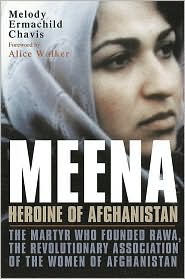
Meena, Heroine of Afghanistan, a new book by Melody Ermachild Chavis

meena“A vivid celebration of a contemporary heroine.” – Kirkus Reviews

Click here
to purchase a copy of the book.

Click here for more information.

Book Description
Meena founded the Revolutionary Association of the Women of Afghanistan in 1977 as a twenty-year-old Kabul University student. She was assassinated in 1987 at age thirty, and lives on in the hearts of all progressive Muslim women. Her voice, speaking for freedom, has never been silenced. The compelling story of Meena’s struggle for democracy and women’s rights in Afghanistan will inspire young women the world over.

Meena, Heroine of Afghanistan is a portrait of a courageous mother, poet and leader who symbolizes an entire movement of women that can influence the fate of nations. It is also a riveting account of a singular political career whose legacy has been inherited by RAWA, the women who hold the keys to a peaceful future for Afghanistan. RAWA has authorized this first-ever biography of their martyred founder.

A radical passion for justice
LA Times Book Review by Susan Griffin, March 2004

On the surface, “Meena, Heroine of Afghanistan” is a very simple book. Since this account of the life of the founder of the Revolutionary Association of the Women of Afghanistan, or RAWA, is told for girls as well as women, the style is conventional and direct. Yet the narrative will provide a profoundly moving experience for readers of any age. In fact, the story of the young woman who at the age of 20 started the first movement for women’s rights in Afghanistan, only to be assassinated 10 years later, is a page turner.

Meena’s story cannot have been easy to piece together. Readers will benefit from the experience of the author, Melody Ermachild Chavis, who in her career as a private detective has investigated numerous murder cases. In the course of her research for this book, she traveled to Afghanistan to interview many of the principals — men and women who, even after the Taliban was overthrown, were still in danger of attack by fundamentalist terrorists because of their support of women’s rights.

Those readers unfamiliar with the lot of women under the Taliban will be shocked by the conditions revealed in this book. Yet the logic of the oppression will not, unfortunately, be entirely unfamiliar to Westerners, who see various forms of repression imposed on women in Christian fundamentalism and ultra-Orthodox Judaism. Claiming that women are spiritually and intellectually inferior as well as sexually dangerous, the Taliban promoted male domination both in the family and in public life through various forms of repression, including the imprisonment of women in the home, the imposition of the veil and the burka, the denial of the vote and of education, the exclusion of women from the clergy and places of worship, and opposition to abortion, affirmative action and the employment of women outside the home.

In 1957 — the year Meena was born into a middle-class family in Kabul — Afghanistan was ruled by King Zahir Shah, a monarch who supported some measure of equality for women. Afghanistan’s modern history can almost be read as an exercise in violent ambivalence concerning democracy and women’s rights. Amanullah Khan, who ruled Afghanistan from 1919 (the year the country won full independence from Britain) until he was deposed in 1929, began a program of modernization that included education for women. Nadir Shah, king from 1929 to 1933, abolished Amanullah’s reforms, but Nadir’s son Zahir, who succeeded him after Nadir was assassinated, advanced Amanullah’s liberalizing policies even further, establishing a constitution in 1964 that gave women the right to vote.

It was thanks to these innovations that Meena received an education — unlike her mother, who was illiterate. Lycee Malalai, the all-girls school she attended, was named for an Afghan heroine who in 1880, when the country was invaded by Britain, had retrieved under gunfire a fallen Afghan flag and held it high until she was shot down by British soldiers. Inspired by this story and by two of her teachers who believed in the equality of women, Meena eventually became a heroine herself to countless Afghans, legendary even before her martyrdom at age 30.

After graduation, Meena intended to study law so that she could fight for women’s rights in the courts. But by then the liberal atmosphere that had fostered her determination had dissipated. Three years earlier, Zahir was overthrown by his prime minister and cousin, Mohammed Daoud, who was aligned with a pro-Soviet party. Gradually Afghanistan lost its independence, and the government became unstable. Fundamentalist groups began interpreting every democratic reform as a sign of corrupting foreign influence, and emancipated women were their first targets. By 1976, when Meena entered the University of Kabul, its female students had to contend with a reign of terror as random attacks were carried out on them. The followers of the Islamic radical Burhanuddin Rabbani threw acid on the exposed legs and even the faces of women walking across the campus — the beginning of hostilities that continue to this day.

Meena did not let these attacks stop her from attending the university or from speaking out for women. The resolve and bravado for which she was soon to become famous showed itself in a family drama culminating that year with her marriage. Meena was 19 years old. Because according to Afghan tradition a girl is considered marriageable at 13, the pressure from members of her extended family for her to wed had reached a fever pitch.

Meena’s standards seemed impossible to fill. She did not believe in, nor would she consent to, a bride price, let alone an arranged marriage. She would not wear the veil; though polygamy was still the custom in many households, she insisted that her husband should take no other wives; she demanded that she be allowed to continue her studies; and she made it clear that she planned not only to practice law but to hold her own political views as well. Eventually an enterprising aunt found Meena an acceptable husband in Faiz Ahmed, a distant cousin who was a doctor with radical views, including a belief in women’s rights. Because he agreed to all her conditions and she liked him, Meena agreed to the union, though in the beginning she was not in love with him.

If over time she would come to love Faiz, she never agreed with his Maoist politics. She seems to have rejected ideology altogether, favoring instead the complexities that inform the lives of real women. Still, she watched and learned from her husband’s political activism. Increasingly, it seemed to her that the courts were not the only way to better women’s lives. She decided to start a political organization for women. Influenced by her husband’s organization, which under a pro-Soviet regime had to be clandestine, she found a way to build RAWA while keeping its membership secret. Interestingly, her method was similar to one used by American feminists of the late ’60s and ’70s: a constellation of small groups. Though Meena met with all the groups, they did not meet with one another, making it easier for women to keep their membership secret and thus evade the disapproval and draconian retaliation of their families. This approach also afforded great intimacy, which helped give its members an uncommon strength and courage.

In the beginning, some of Meena’s tactics, such as wearing a burka when visiting members’ houses, seemed unnecessary, but soon the wisdom of this approach became all too clear. When Daoud was assassinated in 1978, thousands of Afghan intellectuals were imprisoned or executed. The following year, after the Soviets invaded Afghanistan, all other political points of view were brutally repressed. That officially the Soviet regime supported women’s rights made RAWA’s task no easier. Indeed, educating women about their rights became more difficult under a hated government that was forcing its ideological program on an occupied people.

Soon Meena’s life became more difficult in still other ways when, because he was a Maoist, Faiz and Meena were forced to separate. Meena continued to organize women, even during the last month of her pregnancy. On the day her labor began, Faiz was arrested. Fearing that she too would be imprisoned, Meena went to the hospital at the last minute before giving birth, leaving in disguise only hours afterward. In one of the more wrenching episodes of her story, she decided to leave her newborn child with a friend before going into hiding herself. Faiz was finally released from jail, but he was able to visit his wife and daughter only briefly before he fled to Pakistan.

Though matters would soon become significantly worse under the warlords and fundamentalist mujahedin who finally overthrew Soviet rule, under Meena’s leadership RAWA continued to publish and distribute leaflets, hold literacy classes and build its organization through the continual spawning of small groups of women. Eventually Meena herself was forced to go to Pakistan. But she continued to work for RAWA there, establishing literacy classes and a home for refugee Afghan women and children. She was close to finishing work on a hospital intended to serve refugees and those injured by land mines when she was murdered by an Afghani who had been acting as a RAWA supporter.

The author’s description of Meena’s considerable physical beauty, burnished by a passion for justice that gave her a luminous quality, is verified by the photographs accompanying the book. As one learns about how she would go out dressed as a man, or show up at the home of a member who was ill or suffering a loss, bringing food or offering to cook, even while she was pregnant and exhausted, one comes to love this woman.

There is no comfort in the supposition that since Meena was a political activist, her suffering must have been exceptional. A piece about Afghan women written by Jane Kramer for the New Yorker makes it clear that over the last two and a half decades most of the women of Afghanistan have suffered terribly, often in almost unspeakable ways. Kramer quotes Zahir Tannin, once editor of a prominent daily paper in Kabul and now head of the Afghan desk at the BBC: “No one wants to talk about it but the one thing [Afghans] do agree on is that the biggest victims of our twenty years’ war are women.” If Meena was exceptional it was because she fought back and took joy in the fight – – a joy shared by the women of RAWA, who, as they continued Meena’s work under the Taliban, chose as an act of defiance to wear bright toenail polish under the burka.

In her moving foreword to the book, Alice Walker writes, “One day one hopes the whole of Afghanistan, healed after so many centuries of war, will look upon the smiling radiant face of Meena and recognize itself.” If, as Walker writes, the male leaders of Afghanistan live “under the illusion that she is separate from them,” so too does the current world leadership. The 1951 Geneva Convention relating to the status of refugees still defines “refugee” as someone running in fear from persecution for reasons of race, religion, nationality, even membership in a particular social group or because of holding a political opinion, but not persecution due to gender.

The world would do well to take this widespread persecution seriously. Its victims are also often startlingly prescient. What would have happened had world leaders listened to Meena in 1981, when, after attending an international conference of socialists in Paris to protest the Soviet occupation of Afghanistan, she warned in a televised interview of the dangers of violent Islamic fundamentalist movements? When Afghanistan’s public educational system collapsed, Meena and others in RAWA saw the danger, but the American government took no heed. Despite pleas for help, no money or support was given to RAWA for its schools and hospitals. Yet the Islamic fundamentalist schools, established during the Soviet occupation by, among others, Osama bin Laden — and that trained many future terrorists — were well funded by several nations, including our own.

This is a book not only to read but to urge others to read. It provides, in its devastating way, a measure of hope. Another way of preventing violence exists: not through repression but through the expansion of civil liberties.

Susan Griffin is the author of several books, including “A Chorus of Stones” and, most recently, “The Book of the Courtesans.”

Posted in Afghanistan News Wire | Comments Off on Meena, Heroine of Afghanistan, a new book by Melody Ermachild Chavis

RAWA at the World Social Forum: “No Photographs, please!!”

RAWA at the World Social Forum: “No Photographs, please!!”

Published on January 19th 2004 by Mid Day, India

by Mayank Shekhar

Jan 19, 2004

“I request you to please not carry my picture in the newspapers. I am under threat and may get identified if I go back to Afghanistan,” appeals prominent Afghani social activist Saher Saba.

For participants of the World Social Forum, who’re sitting comfortable in the notion that Afghanistan has at last inched back to normalcy, Saba’s speech yesterday was an eye-opener.

Saba (26) perhaps the youngest speaker at the WSF, still lives in exile in Islamabad, fearing arrest if she goes back. As she said, “New government, old government, no difference.”

Saba heads the Revolutionaries Against War in Afghanistan (RAWA), an NGO that rehabilitates Afghan refugees in Pakistan. Here are excerpts from an interview.

You mentioned in your speech that the Northern Alliance (the most important element of the present coalition government in Kabul) is similar in its ideologies and actions to the Taliban. Explain.

There are many in the world who believe that the Taliban are the only ones who are fundamentalists, which is not true. There are many more ‘jehadis’ and all have traditionally been supported by foreign governments. In Afghanistan, they enjoy no local support.

As for the Northern Alliance, you need to go back in history to look at what they’ve done. The fact that the Taliban closed down schools was publicised, but it was the Northern Alliance that destroyed the schools. They were the first ones to throw acid at women who did not wear ‘burqas’.

They posed democracy as a concept for ‘infidels’ (anti-Islamics) and said women were not part of general civil society.

We recently heard the Grand Assembly state that the women must not consider themselves equal to men. There is absolutely no difference between the fundamentalism of the Taliban and that of the Northern Alliance.

You also mentioned that the New Constitution drafted with American approval for the people of Afghanistan still remains anti-women.

Just for the record, there is actually no ‘new’ constitution. It is the same old constitution. Women are still not given any constitutional guarantees. The constitution mentions general points on human rights, but there are no specifics detailed. And this is not a document based on secular and democratic values.

That apart, even if we assume upon ourselves the world’s best constitution, who will implement it, its prime violators? We need the world to know this.

Despite the change in government, why do you face direct threat of arrest if you land in Afghanistan? Surely there must be international bodies you can address your complaint to…

They will not arrest me openly. But the government will find a way to harass and arrest me if they know I belong to RAWA. I am aware of that threat and cannot afford to be identified by the authorities if I do go back.

Posted in AWM News | Comments Off on RAWA at the World Social Forum: “No Photographs, please!!”

Afghan Women’s Mission Calls for Increased and Improved Reporting on Afghanistan

FOR IMMEDIATE RELEASE

CONTACT
Voice: 626-676-7884
E-mail: info_at_afghanwomensmission.org

Altadena, CA – (March 25, 2005) The current state of social, economic, and political rights in Afghanistan is so dismal that a US-based advocacy group is calling for major news outlets to have more coverage of the country, with better reporting.

“Most US media institutions don’t have full-time reporters in Afghanistan anymore,” said Sonali Kolhatkar, co-director of the Afghan Women’s Mission (AWM), Altadena, CA. “Much of the limited reporting coming out of Afghanistan has a misleading positive spin and is focused on superficial change. Despite their joy at being able to vote in elections last October, Afghan people are saddened that the United States has seemingly once more forgotten them.”

Kolhatkar and fellow co-director James Ingalls recently returned from a trip to Afghanistan. Kolhatkar is also the host of the LA-based radio program Uprising and Ingalls is a staff scientist at the California Institute of Technology and a freelance writer. They surveyed projects funded by AWM and operated by RAWA, the Revolutionary Association of the Women of Afghanistan, which runs hospitals, orphanages, emergency relief programs, schools for children, and literacy courses for adults; and conducts peaceful demonstrations for women’s rights.

“Very little has changed since the Taliban fell. Yet US media outlets have, through their inaccurate coverage and, more recently, lack of coverage, given the impression that women are now free, educated, and employed, and have political and economic equality. Nothing could be further from the truth,” said Kolhatkar. Ingalls commented that women’s access to employment, education, health care, and housing, as well as their ability to have a voice in the new government, “are directly impacted by the continued US and Afghan government backing of warlords and regional commanders, a fact nobody wants to talk about in the US.”

During their visit, the AWM co-directors were able to witness many of the problems that beset Afghan women and girls, and to interview them about their opinions on the current situation in Afghanistan. “We don’t see why news organizations shouldn’t be able to do what we did,” Kolhatkar added. The Afghan Women’s Mission praised Human Rights Watch, Amnesty International, and other non-governmental organizations for their independent and steady coverage of Afghanistan.

The group is urging its supporters to write to US media outlets, asking for better coverage of Afghan women’s issues. A webpage (https://www.afghanwomensmission.org/campaigns/media_coverage.php) provides a letter that can be edited and then automatically mailed to national newspapers and radio syndicates: the New York Times, LA Times, Newsweek, the San Francisco Chronicle, the Boston Globe, Washington Post, Chicago Tribune, the Guardian (London, UK) , CBS 60 Minutes, and National Public Radio.

The Afghan Women’s Mission works in solidarity with RAWA to help improve health and educational projects for Afghan women, as well as promote democracy and women’s rights. Visit AWM’s website at www.afghanwomensmission.org.

For more information about the social and political work of RAWA, visit their website, www.rawa.org.

Posted in Press Releases | Comments Off on Afghan Women’s Mission Calls for Increased and Improved Reporting on Afghanistan

Sadaa E Zan (Voices of Women)

sadaa e zanWinner of 2003 Social Justice Documentary Award at the Santa Barbara International Film Festival

Filmed in March 2002, Sadaa E Zan collects the voices of several Afghan women living in Kabul, Afghanistan and Northern Pakistan. In a land where 50% of women are widows and nearly everyone has lost a family member, these brave women, of all ages, recount their struggles and victories from living under 23 years of war. From the Soviet invasion to the Civil War to the extremist Taliban, be it fighting, poverty, rape or seclusion, women were always the first victims. How did they survive?

Several reveal their stories of rebellion, be it housing an illegal home school for girls, hidden work training programs, an underground beauty parlor or a refugee medical clinic. Most of the women, despite their hardships, did not lose their morale and spirit. However, family loss and suffering has taken a deep toll on society as a whole and women are learning that psychological damage is now their new enemy.

With the Taliban now gone, Afghanistan finally finds itself with the possibility of peace. But will it last? This, they believe, is in the hands of the international community. Finally, these women have a way to voice their concerns. Listen as they speak directly to you about their hopes, beliefs and concerns for not only the future of the Afghan woman but for the country itself.

Despite all the media I’ve seen on the plight of women in Afghanistan, here, for the first time, I was able to listen to the women themselves… to hear their words, their stories, see their expression in their eyes. With this video, the Afghan women’s voices can finally be heard.” — Renee Bergan, producer and director

Find out more about the film here.

Posted in Films About Afghanistan | Comments Off on Sadaa E Zan (Voices of Women)

Afghan Women’s Mission Marks Second Anniversary of US Bombing

FOR IMMEDIATE RELEASE

CONTACT
Voice: 626-676-7884
E-mail: info_at_afghanwomensmission.org

On the occasion of the 2nd anniversary of “Operation Enduring Freedom” and the US bombing of Afghanistan, The Afghan Women’s Mission is organizing a vigil in memory of Afghan civilian victims of the US campaign. The vigil is also intended to highlight that almost two years after the toppling of the Taliban, Afghanistan is as far from peace, democracy and stability as it was before September 11th, 2001.

The vigil will be held on Tuesday the 7th of October, at 6:30 pm at the Westwood Federal Building, 11,000 Wilshire Blvd, in West Los Angeles. Participants are encouraged to bring candles, signs, and any other expressions of solidarity.

According to AWM volunteer Heather Schreck who is spearheading the vigil, it is a “message of love and solidarity to the citizens and refugees of this war torn country. We want to have as many people as possible and to make a strong statement that day. Two years is long enough and the citizens of this country have paid too large of a price!”

The Afghan Women’s Mission is a non-profit US-based organization working in solidarity with the Revolutionary Association of the Women of Afghanistan (RAWA). RAWA supports the Tuesday vigil and confirmed that the US war has not improved conditions. According to RAWA:

“The US “war on terrorism” has caused so many miseries to our innocent people… It is painful to hear some Western leaders and media speak frequently about the “liberation” of Afghanistan. Our land is not free yet. The people of the world should know that though the disgusting, ludicrous and oppressive rule of Taliban was over in our ill-fated Afghanistan, but this never means the end of the horrible miseries of our tortured nation. Because contrary to the aspirations of our people and expectations of the world community, the Northern Alliance, these brethren-in-creed of the Taliban and Al-Qaida are again in power and generously supported by the US government. It has completely shattered the dream of our wounded people for liberation from the heavy chains of the Taliban tyranny, because the NA is nothing but a fragile coalition of a “batch of bandits” -according to the UN especial envoy- with a long list of crimes and brutalities. Afghan people will never forgive them for the crimes they committed along with the so-called older generation of the Alliance, i.e. Dostum, Khalili, Sayyaf, Rabbani, Gulbuddin etc. while in power from 1992 to 1996. Only in Kabul 50,000 where killed during these bloody years.

The war in Afghanistan has removed the Taliban, which so far does appear to be an improvement for women in certain limited parts of the country. In other areas, the incidence of rape and forced marriage is on the rise again, and most women continue to wear the burqa out of fear for their safety. The level of everyday violence in Afghanistan is something we would find it hard to imagine. “War on terrorism” has removed the Taliban, but it has not removed religious fundamentalism which is the main cause of all our miseries. It will require a very different approach indeed for those evils to be eliminated, which is RAWA’s point. And in fact, by reinstalling the warlords in power in Afghanistan, the US is ultimately replacing one fundamentalist regime with another.”

The Afghan Women’s Mission aims to empower Afghan women by improving the education and health facilities of Afghan refugees, many of whom are women and children.

More information about RAWA’s humanitarian work is available on their website, http://www.rawa.org.

Posted in Press Releases | Comments Off on Afghan Women’s Mission Marks Second Anniversary of US Bombing

Malalai Hospital Patient Writes to RAWA

September 2003.

One among scores of Memories being left by patients at Malalai Hospital.

Malalai HospitalI have come along with my three year old child named Nasir and have spent eight days in this hospital. I have observed everything very carefully, from the cleaning of the hospital to the good attitude of the staff and RAWA members.

I cannot express my feelings regarding your hospital. I do not know with what words I should thank RAWA members, the hospital staff, and the kind supporters of RAWA who have helped RAWA to establish this hospital. In the hospital they welcome each patient like a guest. I have never seen any hospital where they have cooked food for the patient according to their desire and the doctor’s advice.

My son is suffering from malnutrition and a fever. In addition to three meals a day, they give egg, milk, and fruit daily to him. Although I have said many times that: “The patient’s relatives bring fruit.” But they have never paid attention and instead take care of him as before. Believe me, I have never seen or heard of such a hospital in ruined Afghanistan or in Pakistan.

More important than anything else is the visits of RAWA members to this hospital. They are very kind and generous people. They wear simple clothes. They talk with almost all patients, asking about their difficulties, their past, and they give them hope of a bright future. That is the reason I want to praise RAWA and its great leader Meena who has left such wonderful followers behind. I hope they will be more successful in their future activities.

I found two boxes [in the hospital]. One box was for complaints and one was for memories. I had no complaints and in order to praise and show respect for their generosity I started writing some of my memories of the one week I was in this hospital.

With regards,
Razia

Posted in Reports | Comments Off on Malalai Hospital Patient Writes to RAWA

Afghan Women’s Mission Endorses “Occupy the Occupiers”

FOR IMMEDIATE RELEASE

CONTACT
Voice: 626-676-7884
E-mail: info_at_afghanwomensmission.org

The Afghan Women’s Mission, along with Not in Our Name, and International ANSWER invite Southern Californians to join them in occupying the lawn of the Westwood Federal Building this Friday, August 22, in “Occupy the Occupiers”. The event begins at 12 noon and continues until 10 pm, featuring speakers including Sonali Kolhatkar, Vice President of AWM. There will also be musicians and poets.

There will be a multicolored patchwork of tents, each with its own theme. Set up your own tent, complete with banners, photos, and messages of resistance!

BACKGROUND:

On October 7th 2001, the United States began a military campaign against Afghanistan. The bombing lasted several months, during which the ruling Taliban were defeated and thousands of innocent civilians were killed. In the summer of 2002, the US installed a puppet government in Kabul, with Hamid Karzai, an Afghan exile, at the head. US-financed Afghan warlords with a history of human rights abuses, obtained high positions in the government and control parts of Afghanistan outside Kabul, constantly fighting one another and undermining the central government.

There are currently about 12,000 foreign troops in Afghanistan, of whom 8,000 are US and British troops. US troops have been increasingly targeted by rocket launchers and other attacks.

LIBERATION or OCCUPATION?

An August 19th article in Reuters entitled, “US Troops Provoke Anger, Fear in Afghan Villages” is indicative of the growing unrest in Afghanistan against US occupation. “When U.S. forces entered a remote Afghan village recently to hunt Taliban and al Qaeda rebels, locals hurriedly hid their Korans in a sack. B affled soldiers who discovered the copies of Islam’s holy book asked an elder what was happening. He told them that villagers feared they would be killed merely for being Muslims. The misunderstanding underlines the depth of confusion and mistrust caused by foreign troops in Afghanistan, particularly in rural areas in the South and East where the coalition is most active in its hunt for “terrorists.” In many cases that mistrust has turned to hatred, as aggressive search tactics and a general sense among Muslims of being under siege plays into the hands of the very people the U.S. military is trying to wipe out.

“On the slightest suspicion they arrest us and treat us like animals,” said Haji Allah Dad, a 50-year-old resident of Sher-o-Aba, a village 4 miles east of the town of Spin Boldak on the border with Pakistan. “Their treatment is so inhuman that sometimes we even think of joining the ‘jihad’ (holy war) of the Taliban against them.” Villagers in Sher-o-Aba are incensed at what they call arbitrary arrests and physical abuse by U.S. troops, who clashed with suspected Taliban sympathizers in the area in late July.

U.S. forces, aid workers, foreign peacekeepers and government troops are all facing a rising threat in Afghanistan, with no apparent let-up in the hit-and-run tactics of Taliban or al Qaeda militants operating from along the Afghan-Pakistan border.

************

According to the Revolutionary Association of the Women of Afghanistan (RAWA), the oldest feminist Afghan group, and the only Afghan group to join the worldwide antiwar movement, the US has NOT “liberated” Afghanistan:

The people of the world should know that although the despicable and oppressive rule of the Taliban is over in our ill-fated Afghanistan, this does not mean the end to hardship for our tortured nation. It is painful to hear some Western leaders and media speak frequently about the “liberation” of Afghanistan. Contrary to the aspirations of our people and the expectations of the world community, the Northern Alliance, these brethren-in-creed of the Taliban, are once again in power and are generously supported by the US government. In fact, by reinstalling the warlords in Afghanistan, the US is ultimately replacing one fundamentalist regime with another. The Northern Alliance is nothing but a fragile coalition of bandits with a long list of crimes and brutalities.

The Taliban have been severely criticized as the most brutal rulers in view of their actions against women, but the media has not given much coverage to the anti-women values and atrocities of the Northern Alliance, who were the first to impose misogynic rules on our women.

The US war has not brought any significant positive changes to our country. It is crystal clear that the US did not enter Afghanistan to liberate its people, but to punish its own wayward creations – Osama bin Laden and the Taliban.

Because of our unambiguous comments on these matters, some people call us “anti-American”. However, we love the people of America and greatly appreciate their humanitarianism, their generous financial help and their heart-warming moral support. As is the case for many peoples and countries in the world, there is a difference between the US people and the US government.

The work of RAWA is even more difficult inside Afghanistan in such a climate. We cannot even sell our publications openly and those who are caught reading or selling them are threatened and tortured. No serious anti-fundamentalist women’s organization can operate openly in today’s Afghanistan.

– Excerpted from a speech of RAWA member, Brussels, May 16th 2003.

The Afghan Women’s Mission aims to empower Afghan women by improving the education and health facilities of Afghan refugees, many of whom are women and children.

More information about RAWA’s humanitarian work is available on their website, http://www.rawa.org.

Posted in Press Releases | Comments Off on Afghan Women’s Mission Endorses “Occupy the Occupiers”

An Afghan Woman’s Story of War and Suffering

Shahgul’s Story of Unbelievable Heartache
Report filed by RAWA based on an interview with the subject, July 2003

ShahgulMy name is Shahgul and I am 50 years old. I am from Ghazni Province. My husband’s name was Muhammad Bakhsh and he served as an army officer. Many years ago we moved to Kabul and we lived in Afshar-e-Silo, an area in the South of Kabul. I had two daughters and two sons. My eldest son was Shafiq. He became an army officer just like his father. We had a middle class life, and we were happy with it.

Before 1992, ethnicity and different ethnic issues were never an issue for us. I never differentiated my neighbors or people around us based on ethnicity. We are Hazaras. Our neighbors to the right were Tajiks from Shamali, while on the left of our house, they were Pashtuns from Kundoz. We had quite a good relationship with each other and lived like a family. My daughters attended the same school as the neighbors’ girls and they were good friends.

In 1992, our area fell into the hands of Hezb-e-Wahdat (the party belonging to Hazaras). Not too far away, the Sayyaf group (who are Pashtuns) were controlling another area and the center of the city was in the hands of Massoud’s forces.

A never-ending struggle and warfare was prevailing all around the area and we were all worried. Frightening faces covered with long beards were roaming around in the streets. Spring had lost its bloom. My husband and my eldest son had lost their jobs. My son said that wild and ignorant people had gained control of everything and we were thrown out.

A fierce clash broke out between the Hezb-e-Wahdat and the United Front groups of Sayyaf and Massoud. It was raining bullets everywhere.

No one dared to leave their house. I was even unable to visit my neighbors for two days since we spent two days in the basement of our house to hide from the bullets.

In the morning of the third day, somebody was kicking the door. In the height of fear, we came out of our basement. We didn’t know who was banging on the door, and the whole street was full of people. The old and the young, men and women were running around with bare feet. We thought it was the end of time. They told us to run for our lives because the forces of Massoud were near our area and that they were going to slaughter all Hazaras. We frantically ran to the street not knowing where to go. All the people were leaving behind their belongings in their houses and were escaping for their lives. They didn’t even have the time to lock their doors. I could see the tanks coming towards us.

I witnessed a woman crying beside her wounded son and asking the Jehadies to help her take him to the hospital. The Jehadies didn’t pay any attention to her and kept on moving. I can still hear the cries of that woman. I paused for a few seconds and looked at her. My husband yelled at me, saying that we had to hurry, because they were firing RPGs (rocket propelled grenades). After three hours of constant walking we reached my uncle’s house in Dasht-e-Barchee.

After staying in my uncle’s home for two weeks, we heard on the radio that Rabbani and Mazari had reunited. We thought the situation might be better so we decided to go back to our house and collect some of our belongings. I didn’t let my son and my husband go back because on the way they would stop the men and give them a difficult time. I decided to go to Afshar with my elder daughter and my uncle’s wife.

Afshar was not the same anymore. It was difficult to recognize the streets. You could smell blood all around. A man wearing commando dress (the Massoud group used to wear them) asked us angrily: “Where the hell are you going you donkey Hazaras?” I begged and told him: “Son, I am going to take some of my belongings from my house.” I pleaded that it had been two weeks since we had been away from home and we had nothing. He said: “Why are you lying? You have come as spies for the Hazaras.” I cried: “Son, I am an old poor woman, and we don’t have anything to do with Hazaras or the any other ethnic group.” He said: “You can go to your house, but don’t look around.”

ShahgulNear the house, on the street, I noticed our family photo and picked it up. Our house had been looted. I noticed from a distance that Massoud’s forces were busy taking our car out of the house. I walked towards them and I wanted to scream, but I didn’t have the courage to go near them with my young daughter. I was afraid that they might do something to me and to my daughter. We went a bit closer, they asked again who I was and what I wanted. Out of fear I couldn’t tell them that the house belonged to me. Instead I said: “I’m going to the other street just to see my house.” In this moment I was trying to take a peak inside our house and noticed that three men were breaking the windows.

I couldn’t stand there and witness these barbaric men destroying my house. They were breaking apart the house that I lived in for many years and shared wonderful memories with my husband and children. We went away as soon as we could. I could hear gun fire and it was escalating every moment. They said that the Hezb-e-Wahdat had begun another attack. I began to realize that we shouldn’t have came here at all. We had to run for our lives again. My daughter and my uncle’s wife were wearing the burqa and I was wearing a chadar, so my face was not covered. My daughter said: “cover your face mother so that they don’t know we are Hazaras.” Her words shattered my heart. I had to cover my face to hide my identity and save my life.

On the way we had to pass by many dead bodies. I saw a wounded boy trying to get up and waving his hand for help, and everyone was passing by him quickly. Nobody was listening to anyone. I felt like I was in hell. My feet were injured. There was heavy firing going on and we had to take shelter in the Jehadies hiding place. They made us fill their magazines with bullets. We left the front in the evening and got home at midnight. I was speechless when I arrived home and had nightmares the whole night.

Every time I remembered my house I would shed tears. I can’t forget the faces of those men who were taking our car and breaking our windows. Every time I remember that scene I feel like they are shattering my heart.

We started a new life. My sons were selling things in the streets. My husband found a job as a cook. Every night and day was a torture for us. We were witnessing thousands of people grieving and fighting. Every night before going to sleep we would pray to wake up alive the next day.

The Taliban were coming forward while the Jehadies were escaping. We were waiting for even worse days. We didn’t consider Pashtuns our neighbors anymore. They were our enemies.

The Taliban took over the country. After a few days of Taliban control over Dasht-e-Barchee they started coming to our house asking my husband to give out his weapons. We told them we didn’t have any weapons, nor had we ever taken part in any fighting. One day my eldest son and I went to the market. When we returned, there were people gathered all around our house. As I got closer I saw three Talibs by my house. I sneaked inside the front yard without them noticing. My eldest daughter ran crying to me with her head bleeding. When I entered the house, I found my younger son in a corner. He was unconscious along with his little sister. I ran out quickly. The three Talibs were dragging my eldest son with them. I reached them, but one Talib hit me with the back of his gun and I fainted not knowing what happened.

When I opened my eyes, I noticed that people were attending my husband’s funeral. The Taliban had attacked our house with RPGs. My husband was killed; my two daughters and younger son were taken to the hospital.

A woman with her child recounts how her husband was killed in Afshar, west Kabul by forces of Ahmad Shah Masoud in 1993.No one was listening to my cries. I didn’t know who to cry for first. For my elder son whom Taliban kidnapped and I didn’t know where he was; for my husband who had just returned from work and slept forever; for my injured daughter, or for my youngest son who’s legs were amputated in the hospital.

I began to search for my eldest son in the Taliban posts. I was insulted. Everyone was kicking me saying: “Why are you here you Hazara?” I was not successful in finding my son. At last I decided escape to Pakistan because we had no jobs and practically no food to eat.

I live in Khyaban-e-Sir Sayed now. My son, who is lame, works in the tailor’s shop and gets a small salary. I don’t have any other source of income. There are no jobs here for refugees. I have cried so much that now I have pain in my eyes. Some Afghans who live near our house here told me that an Afghan organization had established a hospital for Afghans. So I have come to this hospital for a cure. For the first time after many years I found someone to share my pains with. I found someone who is willing to listen to my miserable life story. I can’t do anything other than pray for those who have made this hospital to help poor Afghans like me.

My heart aches for all the Afghan refugees here in Pakistan, especially for my daughters who have no one but me. If it wasn’t for my daughters, there would be nothing for me to live for.

Posted in Reports | Comments Off on An Afghan Woman’s Story of War and Suffering

Malalai Hospital Saves 9 Year Old Meningitis Patient

Report by RAWA.
July 2003.

Nine-year-old Arezo, the daughter of Haleema and Raqeeb, comes from one of the poorest families of Farah province. She was one of our patients in the month of July.

The doctors, after checking her in Farah, had found that she was suffering from a serious case of meningitis, with a fatality rate of about 90%. They were getting a negative prognosis from the doctors due to a lack of medical facilities in Farah. In order to treat her in a better medical facility, they rushed her to Malalai Hospital in Quetta as soon as they could.

The doctors in Quetta’s Malalai Hospital considered the case dangerous and emphasized that the patient needed serious and costly treatment. Our facilities in Rawalpindi were ready to treat Arezo. She was transferred there by air. After being in the hospital for 16 days under intense observation, Arezo defeated death.

Her parents who had lost all hope, told us: “You and your staff have given us a new Arezo (Arezo means hope). Otherwise we had lost all hope.”

Malalai HospitalWhile leaving the hospital, her father said: “I don’t know how to express my gratitude to you for the joy you have given me. From now on I consider Arezo as RAWA’s daughter. You have given her another chance for life.”

Posted in Reports | Comments Off on Malalai Hospital Saves 9 Year Old Meningitis Patient