Published by Telegraph Magazine, UK
Glyn Strong, 29/09/2007
Death threats and assassination attempts have forced Malalai Joya underground, but she is unwavering in her mission to bring true democracy to her country. Glyn Strong meets Afghanistan’s most outspoken politician. Photographs by Tom Stoddart
For about 9 pounds, a woman can disappear in Kabul. That’s how much it costs to buy a burqa, and behind it she can become invisible. It is no small irony that the garment forced upon Afghanistan’s women during the repressive reign of the Taliban has become the key to freedom for the controversial human rights activist Malalai Joya.
 |
|
Malalai Joya with her bodyguards at a secret address in the backstreets of Kabul
|
But even the burqa cannot always hide Afghanistan’s most famous woman. A visit to a maternity hospital in Kabul last month provoked a security alert. Initial irritation among the pregnant women standing in the dusty heat turned to near hysteria as they realised who was behind the veil. A whisper, ‘It’s Joya, Joya is here,’ spread like electricity through the crowd. Women have been known to walk for miles just to touch her. For them, she is their only real hope for a better future.
Under the Taliban, Afghanistan was notorious for the treatment of its women. Girls were not allowed to be educated beyond the age of eight. Women were barred from working, from being treated by male doctors, from enjoying the most basic freedom of movement, and from appearing in public without the burqa. To those who broke the rules, extreme punishments were meted out.
Today, Afghanistan has a democratically elected government, in which women are well represented: its new constitution requires that two women be elected from each of its 34 provinces. Women make up about a quarter of the country’s parliament. But Taliban insurgency, corruption, the country’s dependence on opium production, and infighting between local commanders over power and territory has left it impoverished and unstable. In many ways, the situation for Afghanistan’s women has not improved, and Malalai Joya, by far the country’s most outspoken female politician, will not stand for it.
Joya’s growing fame, or infamy, has brought enemies as well as admirers. The 29-year-old is a wanted woman in every sense of the word: by the disenfranchised, voiceless people of Afghanistan, by international organisations seeking to honour her, by political supporters who want her to run for president (something she does not aspire to) and, most dangerously, by a growing number of potential assassins.
She has no permanent home, no office and no income. Her home has been bombed, she has survived four assassination attempts – and she predicts that there will be more. As long as Afghan women are still brutalised, denied education and access to constitutional law, she refuses to stay silent.
It was on December 17, 2003, during her first appearance as an elected delegate from her home province of Farah in the country’s newly established national assembly, the Loya Jirga, that Joya became their most controversial and unlikely champion. In a now notorious speech, she insisted that Afghanistan’s fundamentalist warlords, criminals and drug traffickers should not only have no role in shaping the country’s future, but should also be tried as war criminals. The mood in the chamber became ugly as discomfort turned to anger. Unrepentant, Joya refused to either apologise or retract what she had said (and still has not done so). Security guards were called to eject her, and from that point on she was a marked woman.
Her popularity among ordinary Afghans grew and, in September 2005, Joya was elected to the 249-seat national parliament (the Wolesa Jirga), representing Farah province. At 27, she was one of the country’s youngest MPs. After her election Joya became a fierce critic of her fellow parliamentarians, telling journalists, human rights groups and anyone who would listen that though they now wore suits and ties, they were still the same corrupt, greedy, murdering warlords and religious fundamentalists who had contributed to the country’s ruin.
In May this year her enemies retaliated. In an Afghan television interview in Kabul Joya claimed the legislature was ‘worse than a zoo’. When an edited recording was shown in parliament she was found guilty of violating Article 70 of the Rules of Procedure that forbids lawmakers to criticise one another. She was thrown out of parliament and banned until 2009. It was, Joya claimed, a ‘political conspiracy’, and risible given that earlier in the month fellow MPs had made death threats and thrown bottles at her in parliament.
She knows that there is a price on her head. ‘They will kill me, but they will not kill my voice, because it will be the voice of all Afghan women,’ she said earlier this year. ‘You can cut the flower, but you cannot stop the coming of spring.’
By all accounts, Joya is a firebrand, and the clips of her speeches on YouTube, savage attacks on everything from US policy to home-grown corruption – dismissed by her enemies as ‘fanatical rants’ – support this. I am expecting to meet a messianic, chillingly focused politician. Instead, after protracted cat-and-mouse arrangements and body searches, I am received by a tiny, softly spoken, beautiful woman. Joya invites us to sit on the floor of her ‘borrowed’ house; we are all barefoot, and the dim, cushion-strewn room where we drink tea is a welcome respite from the glaring heat of Kabul’s streets.
Joya is married, though reluctant to say much about her husband out of fear for his safety. She is the eldest daughter of a large family: ‘I have seven sisters and three brothers,’ she says. ‘My dad was a democrat. He wanted to be a doctor, but he also wanted to fight for freedom, and, during the era known as Jihad [between 1992 and 1996, another bloody period of infighting before the Taliban took power] he was injured and lost part of his leg.’
As Afghanistan dissolved into chaos, the family became refugees, first in Iran, then Pakistan, and her father’s dreams of a medical career ended abruptly. Recalling the strictures of the killjoy ‘Vice and Virtue Department’ that operated during the years of Taliban fundamentalism, Joya reflects on her own religious beliefs: ‘Islam is a personal issue and many crimes have been committed in the name of Islam, but I am a secular Muslim.’ When representatives from an underground campaign group, OPAWC (the Organisation for Promoting Afghan Women’s Capabilities), came to the refugee camp where 18-year-old Joya lived with her family and offered her the chance to work, she grabbed it. ‘There are no universities in the camps; my family was poor – this was an opportunity to make some money and to serve my people.’
This underground work, covertly teaching literacy to women in Herat during the Taliban regime, was dangerous, and to do so she had to buy one of the hated burqas. ‘My dad and brother laughed. Sometimes when I was afraid that the Taliban would find me, I would knock on a door and ask for water to get off the streets. It was a risk for the students, too, but they gave each other courage.’
After a round of phone calls, and with disguises in place, we prepare to visit a series of ‘friendly’ locations in Kabul with Joya and her armed bodyguards – sometimes as many as six, often using more than one car. Dressed in the blue burqa she describes as ‘a shroud for the living’, she takes us to a suburb of Kabul where we stop at an ordinary-looking house. This is a shelter for women, one of several in the capital that house the victims of violence, forced marriages and a variety of other abuses. The inhabitants, about 20 of them, range in age from 11 to 60, but by far the saddest is Alya – a softly spoken 16-year-old, bartered into a loveless marriage at the age of 12.
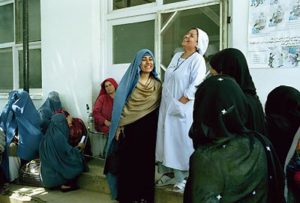
Joya visiting Malalai Maternity Hospital in Kabul
The stumps of what were once her hands are all that is visible of the terrible burns she suffered when her husband and mother-in-law ‘punished’ her for baking a bad batch of bread. They beat her and threw oil on her; in unimaginable desperation, Alya set fire to herself. Now she cannot comb her hair, feed herself or hold a book. Her pain is constant and, despite medication, unrelenting. In a different society, she could look forward to months of corrective surgery to improve her condition, but the procedures involve costly convalescence and care. Her dreams are simple: she tells Joya, ‘I want only three things – to divorce, to heal my hands and to get an education.’ Alya’s plight moves Joya to tears. She fights for control, whispering in English, ‘I’m sorry, I’m sorry.’ She has said many times of the women of Afghanistan, ‘Their suffering is my suffering.’
And their suffering is immense. Statistics published by Cure International, a Christian charity dedicated to transforming the lives of disabled children and their families in the developing world, indicate that every day 44 Afghan women die giving birth. The infant mortality rate is 165 per 1,000 live births (compared with seven per 1,000 in the USA). Other statistics are more shocking still: 87 per cent of Afghan women are illiterate, and only 30 per cent of girls have access to education; one in three Afghan women experiences physical, psychological or sexual violence; the average life expectancy for women is 44, and as many as 80 per cent of women face forced marriages.
The next day Joya is pale and a little distracted. ‘I’m tired,’ she explains when I meet her in yet another temporary lodging. ‘I was up until one this morning. Some-times there is no electricity when I need an internet connection. And I wake at six to listen to news on the radio.’
Normal life for Joya is impossible. She carries with her only a small bag containing little more than a book and a radio. She never sleeps in the same house for more than one night and cannot remember when she last went shopping. She doesn’t wear make-up and she washes her own clothes. A vegetarian, she lives simply. ‘I have a bag that I leave at supporters’ houses,’ she says, ‘but sometimes I need to borrow things.’ The outfit she wore the previous day was such a one. ‘Oh, it was so tight,’ she laughs, ‘but what can I do! My bodyguards and my uncle joke and they call me a bird without wings.’
When she speaks of personal issues, and in rare moments of relaxation, Joya is a different person – wistful, thoughtful, hopeful. Separated by more than 600 miles, she and her husband of two years meet infrequently and clandestinely. Warravaged Helmand – where three British soldiers died during my visit – stands between them geographically, but it is fear for his safety and the murderous venom of her enemies that really keeps them apart. She will not even tell me his name, but talks about their relationship and the children they may never have. ‘I said to him, I know it’s difficult for you; if it’s too difficult for you, divorce me, but he became sad and upset. He loves me very much, I think. Because of my struggle I think it’s better not to have a baby. Even nine months is too much. My life is full of [people’s] suffering – and there are so many orphans. I said we could adopt. Of course my husband would love to have a baby, but we discussed it before we married and he accepted it.’
A student of agriculture, Joya’s husband first saw her at a press conference after the Loya Jirga speech; much later, when she flew back to Farah and got off the aircraft safely, she was told that he cried with happiness to see her. She recalls their wedding: ‘It was a simple marriage party. People brought flowers for me, so many. It was International Women’s Day and I invited everyone – there was just one glass of juice and one cake for everyone – and half a room full of flowers. I said, “This is a free shop; everyone can come and take flowers if they want.”‘
Now she dreams of a day when flowers and vegetables will usurp the ever-increasing quantities of opium grown in her country. (The UN estimates that Afghanistan’s poppy production has risen by as much as 15 per cent since 2006, and that the country now accounts for 95 per cent of the world’s crop.) She also looks forward to a day when women will be treated as equals. ‘In my marriage speech I asked people to think about what they are doing – not to sell their daughters, to give them an education. Some of them laughed.’
No one laughs today. Certainly not the war-hardened men from Rostaq in northern Takhar province, sitting in a semi-circle at Joya’s feet, telling tales of atrocity. None is worse than that of 42-year-old Abdul Halim, whose sons Yusuf, seven, and Fraidon, six, were, he claims, taken hostage by a former Jihadi commander and now member of parliament whom Halim had publicly accused of being a criminal. He claims that, because he spoke out against the crimes, his boys were killed, put into a sack and thrown into a river.
One by one, these men tell of land snatched and relatives murdered. Halim says he has seen President Karzai three times and told him his story. ‘I showed him pictures of my sons and he cried but told me to forget it. He said, “You are young, have more babies.”‘
Only Joya, they claim, stands between the violence of desperation and any last possibility of judicial redress. Is this realistic given her suspension and official powerlessness, I ask. They are adamant that she is Afghanistan’s best hope. ‘Our culture is revenge,’ one man tells me. Halim talks of blowing himself up outside the parliament building if he fails to get justice.
‘We want to make the warlords powerless and we want you back in parliament,’ another tells Joya. ‘It is wrong that someone who does only good is taken from us. We support you because you tell the truth.’
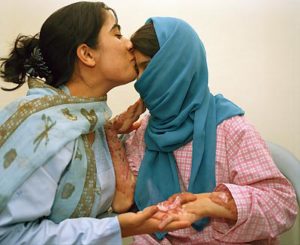
With Alya, who set fire to herself to escape her brutal husband
Although Joya is welcomed everywhere we go, she is enough of a politician to know that it is sometimes diplomatic for organisations and individuals to distance themselves from her outspoken rhetoric. Some are brave enough to support her publicly. A year ago Dr Mohammed Zaher Joya, who runs the neonatal ward at Kabul’s Malalai Maternity Hospital, was kidnapped and beaten by men who believed he was related to Malalai. After being held hostage for two days, he was released when a ransom was paid. Is he bitter? ‘No,’ he says. ‘I support Joya and will help her however I can.’
One organisation that is unflinching in its support is the radical human-rights group Rawa (the Revolutionary Association of Afghan Women). Friba, a spokesman, tells me, ‘Joya is among only a few people in Afghanistan who courageously touch the core issues that are regarded as taboo in our society. Raising these issues is dangerous. Among them, the main and decisive one is the existence of brutal and criminal Jihadi fundamentalists, who only speak in the language of the gun and hold real power today. No one else has been so brave as to publicly call them criminals.’
Joya believes that Britain and America have a responsibility, too. She acknowledges that the withdrawal of international security forces would result in civil war in Afghanistan, but believes that the United States is making a mockery of democracy and the war on terrorism with its support for corrupt Afghan lawmakers. ‘Bush talks about education, but these fundamentalists who are in power are burning schools,’ she says. ‘Bush talks about women’s rights, but women are committing suicide because of violence. They prefer to die than to be alive.’
For the parents of those British servicemen who have died in her country, she has a sobering message: ‘I want to offer my condolences on behalf of the suffering men and women of Afghanistan to those mothers and fathers who lost their dear ones. They think that they come to Afghan-istan to bring democracy, security and human rights, but I tell you that though they shed their blood in Afghanistan, they are not changing the lives of the people.’
Since she was thrown out of parliament and lost her official status, Joya is more vulnerable to attacks than ever, both verbal and physical. At first she was banned from leaving the country but her enemies soon realised that her many absences – ironically, to collect honours and human rights awards – could be used as propaganda against her. ‘I travel alone,’ she explains, ‘and all my journeys are funded by those who invite me.’ Her support base outside Afghanistan is large, and a month after her suspension from the Afghan parliament, an international day of action was observed by her supporters from as far afield as Rome and Vancouver, all demanding that the government re-instate her.
Did she realise what she was getting into when she made that remarkable speech in 2003? She recalls how she felt when she looked around the crowded room and got to her feet: ‘A young man had spoken before me and said something similar. He was threatened and later fled Afghanistan. I thought, I am educated, I have seen the faces of my enemies, I will go on. The thing I feared most was that when the soldiers took me out they would rape me.’
Is she fearful for the future? Not in the conventional sense, although she worries constantly about the security of her family and friends. ‘I’m not frightened, because one day everyone will die. I want to serve my people, especially the women, who are the worst victims. But I believe that no nation can donate liberation to another nation. Democracy, human rights, women’s rights are not something that someone gives to us. We must ourselves make sacrifices to achieve these values.’
Her vision of the country’s future is pragmatic. ‘Society in my opinion is like a bird,’ she says. ‘One wing is man, one wing is woman. When one wing is injured, can the bird fly?’
Read the original article here.


 This year, instead of organizing our own Fair Trade Holiday Bazaar, Afghan Women’s Mission will be participating exclusively in an event called Anti-mall, offering our unique trademark Afghan hand-made items at very affordable prices.


 Afghanistan’s fiercest critic of the warlords, Malalai Joya, returns to the US for a brief visit. She will be addressing students and antiwar activists.
 Sponsored by the Billes Family


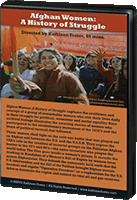 This timely documentary by film maker and photographer Kathleen Foster, dramatizes the tale of a group of remarkable women, how their courage and commitment to change their lives and country has passed from one generation to the next. Their disturbing and amazing stories reflect the recent history of Afghanistan during a quarter-century of cataclysm: from proxy war to civil war, from a Soviet-backed regime to the oppressive rule of the Taliban, and to U.S. military intervention and the current sway of regional warlords and general instability.


